
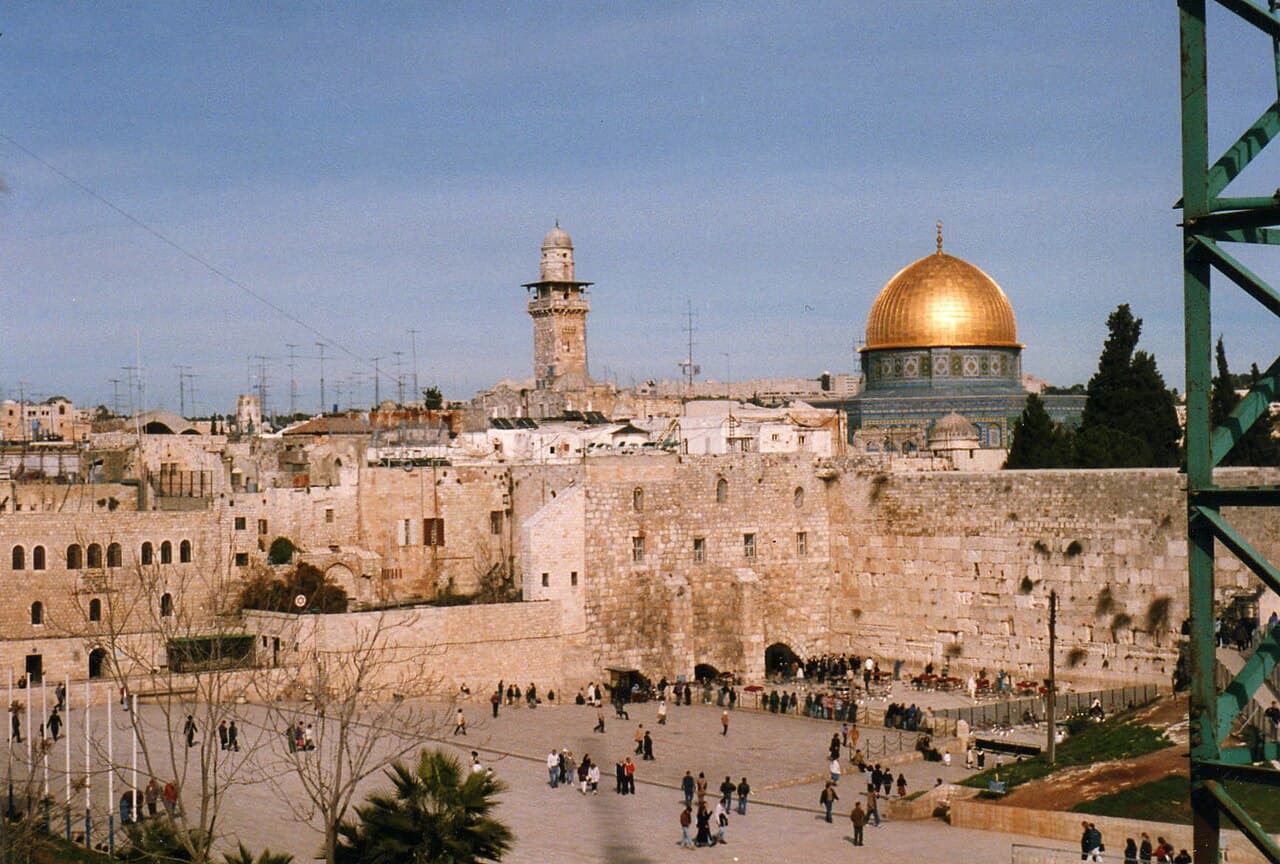
David Holt London, CC BY-SA 2.0, via Wikimedia Commons
Western Wall
HaKotel HaMa'aravi (הכותל המערבי) in Hebrew, Ha'it al-Buraq (حائط البراق) in Arabic
Also known as: Kotel, Wailing Wall, Buraq Wall
Religions: Judaism, Islam | Place Type: Pilgrimage site | Region: Middle East
Overview
The Western Wall is an ancient limestone wall in the Old City of Jerusalem. It is the holiest site where Jews are permitted to pray, being a remnant of the retaining wall surrounding the Temple Mount where the ancient Jewish Temples once stood. The wall is approximately 488 meters long, with the most famous prayer section measuring 57 meters.
Present
The Western Wall Heritage Foundation, a governmental body established in 1988, manages the site. The plaza functions as an open-air synagogue, divided into separate sections for men (larger, left side facing the wall) and women (smaller, right side).
The site hosts major national ceremonies including Memorial Day observances and military induction ceremonies. Bar and Bat Mitzvah celebrations are common, especially on Mondays and Thursdays when the Torah is read.
The Western Wall Tunnels, excavated since 1968, allow visitors to see the full length of the wall underground, including massive foundation stones and remains from various historical periods.
Prayer services occur continuously throughout the day and night, with especially large gatherings on Shabbat (Friday evening and Saturday) and Jewish holidays.
Religious Significance
Judaism
It is the most sacred site for Jewish prayer and pilgrimage. Its holiness is derived from its proximity to the Foundation Stone on the Temple Mount, which is believed to be the location of the Holy of Holies in the ancient Temples.
The Wall is part of the ancient retaining wall that King Herod built to support the Temple Mount platform when he expanded the Second Temple complex (beginning around 19 BCE). When the Romans destroyed the Second Temple in 70 CE, this outer wall survived.
For nearly two thousand years, Jews have come to this wall to mourn the destruction of the Temples and pray for their restoration. The wall is sometimes called the "Wailing Wall" because of the mournful prayers offered here. Jewish tradition holds that God's divine presence (Shekhinah) never departed from the Western Wall, even after the Temple's destruction.
A long-established custom involves placing written prayers (kvitlach) into the cracks of the wall. In accordance with Jewish law, these notes are periodically collected and buried respectfully on the Mount of Olives.
Islam
Muslims call it the Buraq Wall (Ha'it al-Buraq), believing it to be the place where the Prophet Muhammad tied his miraculous winged steed, Buraq, to a ring there during the Isra and Mi'raj—his Night Journey from Mecca to Jerusalem and ascension to heaven.
History & Structure
The visible portion of the Western Wall was built by King Herod the Great beginning around 19 BCE as part of his massive expansion of the Second Temple complex. The wall served as a retaining structure to support the enlarged Temple Mount platform.
When the Romans destroyed the Second Temple in 70 CE, the outer retaining walls survived. Over the following centuries, the lower portions of the wall became buried under debris.
For hundreds of years under Muslim and later Ottoman rule, Jews were permitted to pray at a narrow alley beside a small exposed section of the wall. This area was only about 28 meters long and 3.6 meters wide.
After Israel gained control of the Old City in the Six-Day War of June 1967, the adjacent Mughrabi neighborhood was cleared to create the current Western Wall Plaza. Archaeologists exposed additional courses of the original Herodian stones below ground level.
The wall consists of 45 courses (layers) of stone - 28 above ground and 17 below the current plaza level. The original Herodian stones are the massive blocks with distinctive carved borders visible in the lower seven courses above ground.
Practical Information
- Admission
- Free.
- Best Times
- Early morning or late evening for smaller crowds. Monday and Thursday mornings for Bar Mitzvah celebrations. Friday evening for Shabbat prayers.
- Dress Code
- - Both men and women should dress modestly - Men must cover their heads (paper kippot/yarmulkes are provided free at the entrance) - Women should cover shoulders and wear skirts or pants below the knee (wraps are available if needed)
- Getting There
- The Dung Gate provides the closest entrance. The plaza is also accessible from the Jewish Quarter within the Old City.
- Hours
- The Western Wall Plaza is open 24 hours a day, 7 days a week, 365 days a year.
- Location
- Jewish Quarter, Old City of Jerusalem. Enter through the Dung Gate for the closest access.
- Western Wall Tunnels
- - Tours: Sunday-Thursday 7 AM - evening (varies), Friday 7 AM - 12 PM - Cost: Approximately 40 NIS (adults) - Advance booking recommended: thekotel.org
- What to Know
- - Men and women pray in separate sections - Photography is permitted except on Shabbat and Jewish holidays - Security screening required at entrance - Leave the wall walking backward as a sign of respect