
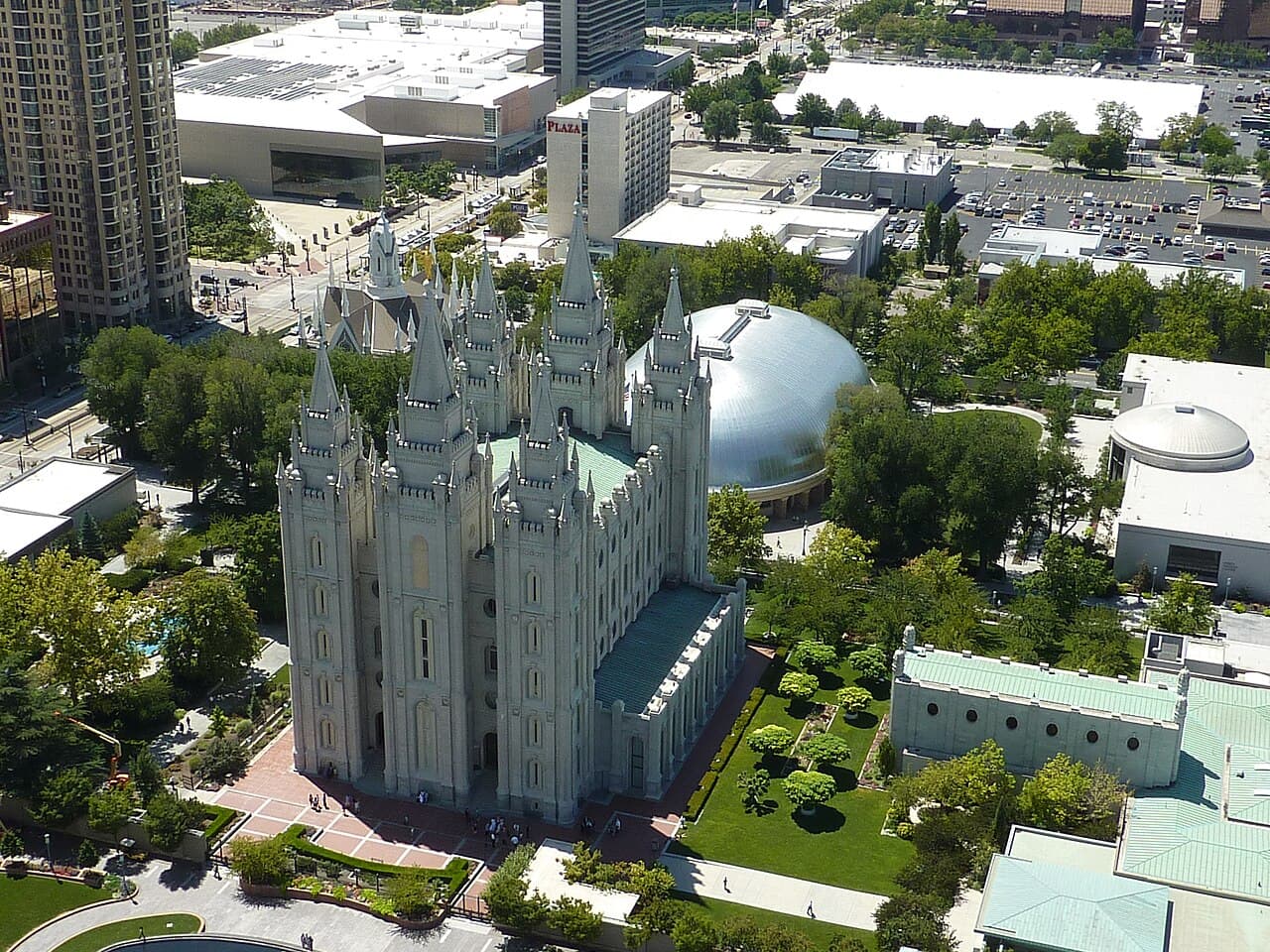
Chris06, CC BY-SA 4.0, via Wikimedia Commons
Temple Square
Temple Square
Also known as: Salt Lake Temple Square, LDS Temple Square
Religions: Latter-day Saints | Place Type: Religious complex | Region: North America
Overview
Temple Square is a 35-acre complex in downtown Salt Lake City, Utah, and serves as the headquarters of The Church of Jesus Christ of Latter-day Saints (LDS Church). It is centered on the Salt Lake Temple, a landmark structure distinguished by six spires. The site includes the Salt Lake Tabernacle, known as the home of the Mormon Tabernacle Choir, as well as the Assembly Hall, visitor centers, landscaped gardens, and historical monuments. Established in 1847 following the arrival of Mormon pioneers led by Brigham Young, Temple Square functions as the spiritual, administrative, and cultural center of the Latter-day Saints tradition. The Salt Lake Temple is undergoing seismic and structural renovation, scheduled for completion in 2026, with public tours planned to resume in 2027.
Present
Temple Square functions as the global headquarters of The Church of Jesus Christ of Latter-day Saints and remains an active center of worship, administration, and public outreach. The surrounding complex includes church offices, the Conference Center—where semiannual General Conference is held and broadcast worldwide—and facilities supporting the church’s international operations.
The square is open daily to the public with free admission. Volunteer sister missionaries offer guided tours in multiple languages, presenting Latter-day Saint beliefs, the purpose of temples, and the historical role of the site. While the interior of the Salt Lake Temple is normally restricted to church members, the surrounding grounds, gardens, and visitor centers are accessible to all.
Temple Square is also a cultural and educational space. The Conference Center and Tabernacle host musical performances, broadcasts, and public events, while the Family History Library provides free access to genealogical records reflecting the church’s emphasis on family history and ancestral ordinances. Visitor centers present religious art, exhibits on church history, and devotional spaces centered on the figure of Christ.
Temple worship is highly structured and devotional, focused on covenant-making and reflection, and participation in its ordinances is reserved for worthy members of the Church holding a temple recommend.
Ongoing renovation of the Salt Lake Temple limits access to some areas through 2026, though most of the square remains open. A public open house planned for 2027 will allow non-members to enter the temple before its rededication, an uncommon opportunity. Today, Temple Square continues to balance its role as a sacred center of Latter-day Saint religious life with its function as a public and welcoming space for visitors of all backgrounds.
Religious Significance
The Church of Jesus Christ of Latter-day Saints (Mormonism)
Temple Square holds supreme spiritual significance as the global headquarters of the LDS Church and the site of its most sacred temple. The Latter-day Saints movement began in 1830 when Joseph Smith published the Book of Mormon, which he claimed to have translated from golden plates revealed by an angel. Mormons believe Joseph Smith restored Christ's original church, which had fallen into apostasy after the death of Jesus's apostles. Core LDS beliefs include: the Godhead consists of three separate beings (God the Father, Jesus Christ, and the Holy Ghost); families can be sealed together for eternity through temple ordinances; ongoing revelation through living prophets; the Book of Mormon as scripture alongside the Bible; and salvation through faith in Jesus Christ, repentance, baptism, and following Christ's teachings.
Temples serve purposes distinct from regular churches (called meetinghouses or chapels). Only temples perform sacred ordinances including celestial marriage (sealing families for eternity), baptism for the dead (proxy baptisms allowing deceased ancestors to accept the gospel), endowment ceremonies (receiving spiritual gifts and making covenants), and other ordinances. Only LDS members in good standing with a temple recommend (certification of worthiness issued by church leaders) can enter temples. This exclusivity preserves temples as sacred spaces set apart from the secular world.
The Salt Lake Temple, the church's symbolic center, took 40 years to build (1853-1893) from granite quarried 20 miles away and transported by ox cart. Brigham Young, the second church president who led Mormons to Utah after Joseph Smith's 1844 martyrdom, dedicated the temple site in 1853.
The temple's design, featuring six spires (the tallest reaching 210 feet, topped with a statue of the angel Moroni), combines Gothic and Romanesque revival styles creating a distinctive silhouette recognized worldwide. The temple has no windows on the ground floor (for privacy and security during early persecution) and features elaborate symbolic architecture and interior artwork depicting LDS theology.
The Tabernacle, completed in 1867, seats 3,500 and houses one of the world's largest pipe organs (11,623 pipes). Its elliptical dome, built without interior supports using lattice arch construction, creates remarkable acoustics—a pin dropped at the pulpit can be heard 170 feet away. The Mormon Tabernacle Choir (now called Tabernacle Choir at Temple Square), founded in 1847, performs weekly broadcasts and tours internationally, serving as cultural ambassadors for the LDS Church.
Temple Square receives approximately 3-5 million visitors annually, making it Utah's top tourist attraction. Most visitors are not LDS members; the site functions as a missionary tool where volunteer sister missionaries offer free tours explaining LDS beliefs.
History & Structure
Mormon pioneers led by Brigham Young arrived in the Salt Lake Valley on July 24, 1847, after migrating from Illinois in search of religious freedom. Within days, Young designated the site of Temple Square as the location for a temple, and the city’s grid plan was laid out with the square at its center. Construction of the Salt Lake Temple began in 1853 and continued for 40 years, slowed by limited resources, political conflict during the Utah War, and the challenges of quarrying and transporting granite from Little Cottonwood Canyon. The temple was completed and dedicated in 1893. Built of granite with walls up to nine feet thick, the exterior incorporates symbolic elements drawn from Latter-day Saint cosmology, including sun, moon, star, and earth motifs.
Other major structures on Temple Square include the Tabernacle (1864–1867), known for its self-supporting elliptical dome and large pipe organ; the Assembly Hall (1882), constructed from leftover temple granite; and later additions such as the Family History Library and visitor centers. The Salt Lake Temple closed in 2019 for its first comprehensive renovation, including seismic upgrades and interior restoration, scheduled for completion in 2026, with a public open house planned in 2027 before rededication.
Practical Information
- Accessibility
- Temple Square is fully wheelchair accessible with paved paths, ramps, and accessible restrooms. Wheelchairs available for loan at visitor centers.
- Accommodation
- Downtown Salt Lake City hotels range from $80–250 per night. Book well ahead for General Conference weekends and Sundance Film Festival (January).
- Admission
- FREE entry to Temple Square, visitor centers, tours, organ recitals, and choir broadcasts. No tickets required except for Music and the Spoken Word (free, limited seating).
- Best Time
- April–May for tulips and spring flowers; September–October for mild weather and fall colors. December–January for Christmas lights (very crowded evenings). Weekdays quieter than weekends.
- Dress Code
- Modest dress encouraged (cover shoulders and knees), especially inside buildings. Not strictly enforced on outdoor grounds. Revealing clothing discouraged inside visitor centers.
- Etiquette
- Temple Square is sacred to members of The Church of Jesus Christ of Latter-day Saints. Maintain respectful behavior, quiet voices in buildings, and modest dress. Visitors of all faiths are welcome. Missionaries are friendly and non-pushy; engagement is optional.
- Events
- - **Christmas Lights:** Late November–early January, extensive light displays and nativity scenes; extremely popular and crowded in evenings. - **General Conference:** First weekends of April and October; Temple Square very busy with LDS visitors. - **Music and the Spoken Word:** Weekly Sunday broadcast at 09:30. Free standby tickets distributed from 08:00; arrive early (08:00–08:30). Doors close at 09:15.
- Getting There
- Salt Lake City International Airport (SLC, 7 miles west): taxi/Uber ($25-35, 15-20 minutes), TRAX light rail Green Line to Temple Square station ($2.50, 30 minutes). Downtown hotels: most within walking distance (downtown is compact). By car: I-15 exit to downtown, parking in nearby lots or garages ($5-15/day).
- Guided Tours
- Free guided tours led by sister missionaries depart frequently between 10:00-16:00 daily (30–45 minutes). Available in 40+ languages. Tours cover Temple Square history, gardens, monuments, and LDS beliefs. Informative and respectful; visitors may politely decline further discussion after the tour.
- Key Sites
- Salt Lake Temple exterior (currently under renovation; Angel Moroni statue visible), Tabernacle (interior accessible during organ recitals or choir events), Assembly Hall, Conference Center (free tours), North and South Visitor Centers (Christus statue, paintings of Christ’s life, interactive exhibits), gardens and fountains, Seagull Monument, pioneer and handcart company monuments, Family History Library (free genealogy research with staff assistance).
- Location
- Temple Square occupies a 10-acre block in downtown Salt Lake City, Utah, bounded by Main Street, South Temple, West Temple, and North Temple. Address: 50 W North Temple, Salt Lake City, UT 84150.
- Photography
- Permitted throughout the grounds and exteriors. Limited or prohibited in some interior areas (posted signs). No photography during choir broadcasts. Gardens and temple exterior are especially photogenic.
- Temple Open House 2027
- Renovated Salt Lake Temple interior open to the public April–October 2027. Free timed tickets required (high demand; reserve early). Rare opportunity to see inside a working LDS temple.