
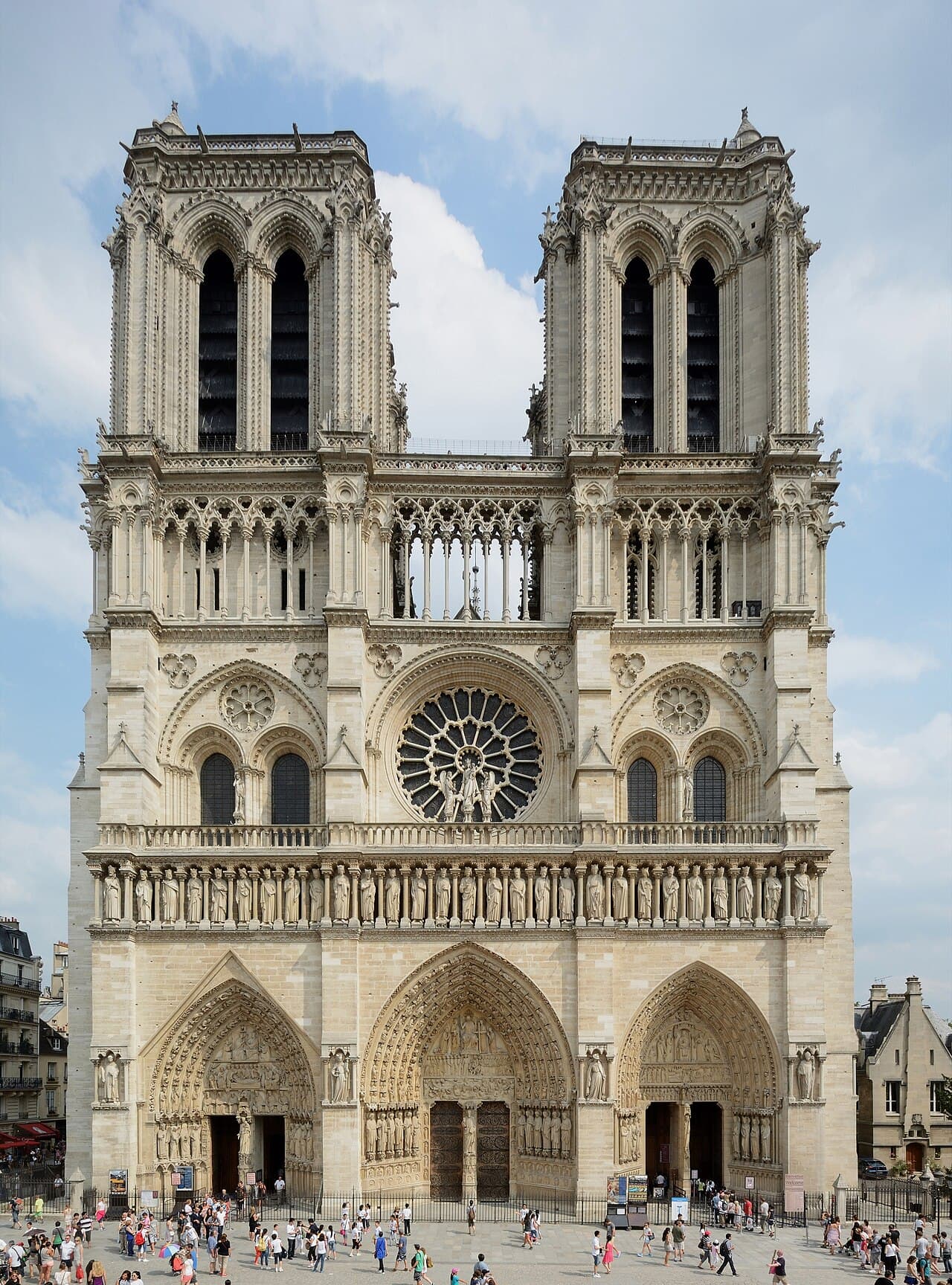
Peter Haas, CC BY-SA 3.0, via Wikimedia Commons
Notre-Dame Cathedral
Cathédrale Notre-Dame de Paris
Also known as: Notre-Dame de Paris, Our Lady of Paris
Religions: Christianity | Place Type: Cathedral | Region: Europe | UNESCO World Heritage Site
Overview
Notre-Dame Cathedral is a medieval Catholic cathedral on the Île de la Cité in Paris, France. The cathedral served as Paris's religious heart for over 850 years. Notre-Dame suffered devastating damage in an April 2019 fire that destroyed its spire and roof, but after five years of intensive restoration, it reopened to the public in December 2024, welcoming over six million visitors in its first six months.
Present
Notre-Dame Cathedral officially reopened to worshippers on December 8, 2024, exactly five years and eight months after the fire. Since reopening, over six million visitors have entered the restored cathedral (as of July 2025), surpassing pre-fire visitor numbers. The cathedral welcomes both religious pilgrims attending mass and cultural visitors admiring the architecture and history.
The rebuilt spire rises once again above Paris, and the cleaned stonework reveals colors not seen for centuries. The restoration retained fire-damaged elements where structurally sound while replacing destroyed portions with new materials crafted using traditional methods. Since September 2025, the towers are again accessible to climbers willing to ascend 387 steps for views over Paris and close examination of chimera sculptures. Daily masses resumed with expanded schedules. The treasury, displaying the Crown of Thorns and other relics, reopened with enhanced security and climate control. Notre-Dame's plaza underwent redesign during restoration, improving pedestrian access and security while maintaining open space for gatherings.
The cathedral continues as seat of the Archbishop of Paris and France's national church for major state ceremonies. The cathedral's bells ring for hours marking the day and for celebrations. Free admission continues, though the reservation system introduced post-reopening manages crowd flow and prevents the extreme overcrowding that challenged conservation before 2019. The cathedral hosts concerts featuring Notre-Dame's restored grand organ, one of France's most celebrated instruments with 8,000 pipes. Archaeological excavations during restoration revealed medieval artifacts, foundations of earlier churches, and Roman-era remains, displayed in new exhibition spaces.
Religious Significance
Roman Catholicism
Notre-Dame de Paris ("Our Lady of Paris") is dedicated to the Virgin Mary, mother of Jesus Christ, whom Catholics honor as the most important saint and advocate for humanity before God. The cathedral functioned as the seat of the Archbishop of Paris and Paris's primary site for major Catholic ceremonies, royal weddings, state funerals, and celebrations of French history. Notre-Dame hosted Napoleon Bonaparte's coronation as Emperor of France in 1804, when he controversially crowned himself rather than allowing Pope Pius VII to crown him, asserting imperial authority over papal power. The cathedral witnessed the beatification of Joan of Arc in 1909 and General Charles de Gaulle's funeral mass in 1970.
The cathedral houses several important Catholic relics, most notably the Crown of Thorns, which Catholics believe Jesus wore during his crucifixion. This relic, purchased by King Louis IX (St. Louis) in 1239 from the Byzantine Emperor for an enormous sum, is displayed on special occasions, particularly Good Friday. Other relics include a fragment of the True Cross and one of the nails used in the crucifixion.
During the 2019 fire, firefighters and cathedral chaplains formed a human chain to rescue the Crown of Thorns and other sacred objects, saving them from destruction. Notre-Dame's three massive rose windows, particularly the North Rose Window (13th century, 21 meters diameter), depict Biblical scenes and saints in stunning colored glass. The cathedral's 10 bells, recast in 2013 for Notre-Dame's 850th anniversary, call Catholics to prayer throughout the day. The largest bell, Emmanuel, weighs 13 metric tons and rings only for major occasions including Christmas, Easter, and papal deaths. Notre-Dame served as a pilgrimage destination for Christians traveling to honor the Virgin Mary and venerate relics. Victor Hugo's 1831 novel "The Hunchback of Notre-Dame" revived public interest in the cathedral during the 19th century when it had fallen into disrepair, inspiring restoration efforts.
History & Structure
Bishop Maurice de Sully initiated the construction of Notre-Dame in 1163 on a site previously occupied by two earlier churches. The project spanned nearly two centuries, concluding in 1345. A significant historical turning point occurred during the French Revolution, when the cathedral suffered extensive damage and was temporarily repurposed for secular worship. This period saw the destruction of numerous original statues, including those of the Judean kings on the western facade.
In the mid-19th century, a major restoration led by Eugène Viollet-le-Duc repaired the revolutionary damage and added the iconic spire. More recently, a major fire in April 2019 destroyed the medieval oak roof framework and caused the collapse of the spire. This event triggered an international restoration effort that employed over 1,000 craftspeople using both medieval techniques and modern technology to rebuild the structure.
The cathedral remains a central site of pilgrimage and devotion, housing significant religious relics and serving as a focal point for the Catholic faith in France. It is recognized as part of a UNESCO World Heritage site for its profound cultural and historical impact.
UNESCO designated the Banks of the Seine (including Notre-Dame) as a World Heritage Site in 1991.
Practical Information
- Accessibility
- Wheelchair accessible via ramps. Ground level accessible; towers not wheelchair accessible (stairs only).
- Admission
- FREE entry. Treasury: €12 adults, reduced rates available. Tower climb (when open): €11 adults, free under 18 (EU residents) or under 26. Bag checks at entrance. Large bags prohibited. Be aware of pickpockets in crowded tourist areas.
- Best times in the day
- Early morning (opening time) or late afternoon. Weekdays less crowded than weekends. Avoid mid-morning-early afternoon peak tourist hours.
- Dress Code
- Respectful attire required. Shoulders and knees covered. Hats removed.
- Getting There
- Metro: Line 4 to Cité station (direct access to island), or Lines 1/11 to Hôtel de Ville, or Line 4 to Saint-Michel. RER: Lines B/C to Saint-Michel Notre-Dame. Buses: Lines 21, 24, 27, 38, 47, 85, 96. Walking distance from major Paris sites (Sainte-Chapelle, Latin Quarter, Louvre).
- Hours
- Monday-Friday 07:45-19:00 (extended to 22:00 Thursdays), Saturday-Sunday 08:15-19:30. Subject to change for religious ceremonies; check official website.
- Location
- Notre-Dame Cathedral is on Île de la Cité, an island in the Seine River in Paris's 4th arrondissement. Address: 6 Parvis Notre-Dame, Place Jean-Paul II, 75004 Paris.
- Masses
- Daily masses resume post-reopening. Check cathedral website for current schedule. Masses typically at 08:00 and 18:00 weekdays, with additional Sunday masses.
- Nearby Sites
- Sainte-Chapelle (royal chapel with stunning stained glass), Latin Quarter, Shakespeare and Company bookshop, Saint-Michel fountain.
- Photography
- Generally permitted without flash. Respect worshippers during mass.
- Reservation System
- Free online reservations via notredamedeparis.fr recommended to skip queues. Walk-in possible but may require 2-3 hour wait during busy periods. Time slots released daily at midnight for date two days ahead. Reservations not required for mass attendance.
- Tower Climb
- 387 steps (no elevator). Access to belfry, gargoyles, and chimera sculptures. Views over Paris. Separate ticket and queue from cathedral entry. Opens 10:00, last entry 45 minutes before closing.