
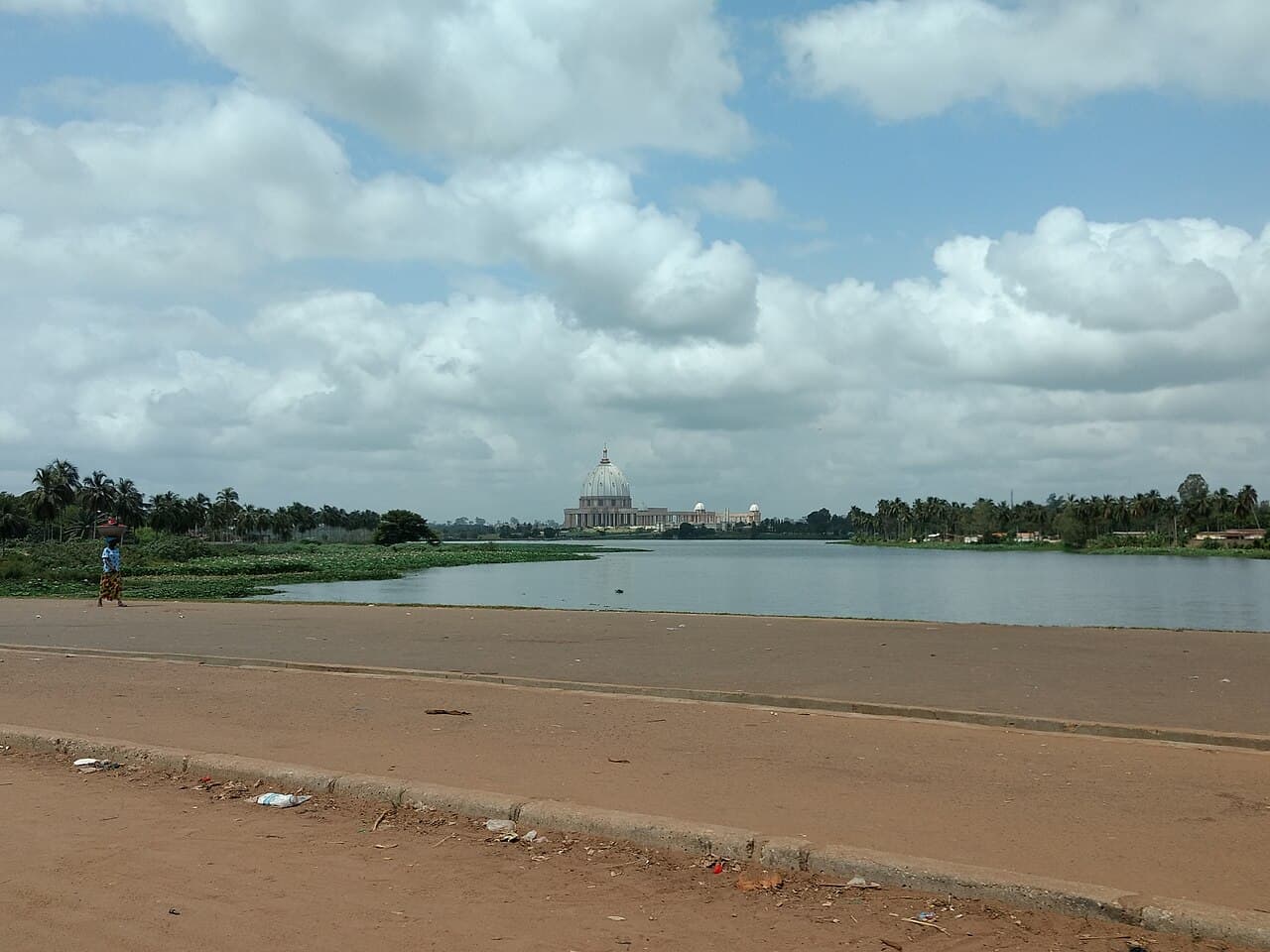
Gregor Rom, CC BY-SA 4.0, via Wikimedia Commons
Basilica of Our Lady of Peace
Basilique Notre-Dame de la Paix
Also known as: Yamoussoukro Basilica
Religions: Christianity | Place Type: Basilica | Region: Africa
Overview
The Basilica of Our Lady of Peace is the largest church building in the world, located in Yamoussoukro, the political and administrative capital of Côte d’Ivoire (Ivory Coast). Conceived by the country’s founding president Félix Houphouët-Boigny and consecrated by Pope John Paul II in 1990, the basilica functions as an active Roman Catholic place of worship and a national landmark, symbolizing both the growth of Catholicism in Africa and ongoing debates about faith, monumentality, and social responsibility.
Present
Today, the Basilica of Our Lady of Peace functions as both an active place of Catholic worship and a national landmark. It remains under the care of the Catholic Church, with support from the Ivorian state for preservation and security. The basilica is open to visitors, pilgrims, and worshippers.
Religious life at the basilica is centered on scheduled Masses, private devotion, and occasional major liturgical events. While the basilica is capable of hosting very large gatherings including episcopal ordinations, national celebrations, and occasional large gatherings, on typical Sundays, the congregation numbers in the hundreds, leaving vast sections of seating empty, given the building's immense size and Yamoussoukro's relatively small population (approximately 300,000).
Beyond worship, the basilica is a destination for Catholic pilgrims from Côte d’Ivoire, across West Africa, and internationally, as well as for visitors interested in its religious and cultural significance.
At the same time, the basilica continues to provoke discussion. Its monumental scale and high construction and maintenance costs remain a point of debate in a country facing ongoing social and economic challenges. For some, it stands as a powerful expression of faith, ambition, and Africa’s place within global Catholicism; for others, it serves as a reminder of unresolved tensions between religious monumentality and social priorities.
Religious Significance
Roman Catholic Christianity
The Basilica of Our Lady of Peace holds religious significance as a consecrated Roman Catholic church dedicated to the Virgin Mary under her title Our Lady of Peace (Notre-Dame de la Paix in French), honoring Mary's role as the mother of Jesus Christ and advocate for peace.
Devotion to Our Lady of Peace emphasizes Mary's role in bringing Christ, the "Prince of Peace," into the world and her ongoing spiritual work promoting peace, reconciliation, and harmony. The building's design directly references St. Peter's Basilica in Vatican City, the spiritual and administrative center of the Catholic Church and the seat of the Pope (the Bishop of Rome and leader of the worldwide Catholic Church). The Basilica of Our Lady of Peace can host major liturgical celebrations, pilgrimages, and high-profile ecclesiastical events due to its large capacity. The building was consecrated in 1990 by Pope John Paul II, who formally accepted it as a gift to the Catholic Church and designated it for sacred use.
At the same time, the basilica has been the subject of sustained debate. Its immense cost and monumental scale drew criticism in a country facing widespread poverty and limited access to basic social services. Acknowledging these concerns, Pope John Paul II made his acceptance conditional on the construction of a hospital intended to serve the poor, reflecting broader ethical questions about the relationship between religious monumentality and social responsibility.
Today, the basilica attracts pilgrims from Côte d’Ivoire, across West Africa, and internationally, and stands as a visible expression of the growth of Catholicism in sub-Saharan Africa. While many Catholics regard it with pride as a symbol of faith and African participation in global Catholicism, others view it more ambivalently, seeing it as a reminder of economic inequality and contested priorities within both church and state.
History & Structure
The Basilica of Our Lady of Peace was conceived by Félix Houphouët-Boigny (1905–1993), Côte d’Ivoire’s founding president, who selected his birthplace Yamoussoukro as the site and later designated it the national capital in 1983. Construction began in 1985 under architect Pierre Fakhoury and was completed in 1989, employing around 1,500 workers from Côte d’Ivoire and neighboring countries.
Built at an estimated cost of $175–600 million USD, the basilica covers 30,000 square meters (320,000 square feet) and rises to a height of 158 meters (518 feet). It features a massive dome spanning 90 meters (300 feet) in diameter, which is more than twice the size of St. Peter’s Basilica’s 41-meter (135-foot) dome. Construction materials included marble imported from Italy and 8,400 square meters of stained glass produced in France. The basilica can accommodate 18,000 people (7,000 seated and 11,000 standing).
The building was consecrated by Pope John Paul II in 1990, marking its formal acceptance into the Roman Catholic Church. As part of the Pope’s conditions for consecration, a hospital was constructed adjacent to the basilica, though it is said to be chronically underfunded.
Following Houphouët-Boigny’s death in 1993, Côte d’Ivoire experienced periods of political instability, including civil wars between 2002–2007 and 2010–2011. Throughout these years, the basilica has been maintained by the Catholic Church, with support from the Ivorian government. The surrounding grounds include gardens and a rectory for priests, while maintenance costs remain substantial due to the building’s scale and reliance on imported materials requiring specialized care.
Practical Information
- Accessibility
- The basilica has ramps and elevators providing wheelchair access to main areas. Smooth marble floors facilitate movement. Access to the dome may involve stairs. Contact the visitor center in advance for specific accessibility needs.
- Accommodation
- Yamoussoukro offers budget to mid-range hotels (approximately $30–100 USD per night), including Hôtel Président and Hôtel des Parlementaires.
- Admission
- Entry fees for international visitors approximately 2,000–4,000 CFA francs ($3–7 USD). Reduced fees may apply for local Ivorians (around 1,000 CFA / $2 USD). Some reports indicate free entry on Sundays after Mass and on major feast days.
- Best Time to Visit
- - November–March (dry season): More comfortable temperatures (25–30°C / 77–86°F), minimal rain - April–May and September–October: Hotter with transitional rains - June–August (rainy season): Heavy rains and high humidity, fewer visitors Weekdays are generally quieter than weekends. Arrive mid-morning or late afternoon for optimal lighting.
- Dress Code
- Modest dress required. Men: long pants and shirts with sleeves. Women: skirts or pants covering the knees and tops covering shoulders. Dress code is more strictly enforced during Mass.
- Etiquette
- The basilica is an active Catholic place of worship. Maintain quiet, follow staff instructions, and do not touch sacred or liturgical items. Non-Catholics attending Mass should not receive Communion.
- Getting There
- From Abidjan: Road travel by car or bus (3–4 hours, approximately 240 km via the A3/A106 highway in generally good condition). Regular buses and shared taxis operate from Abidjan’s Adjamé bus station to Yamoussoukro (fares approximately 3,000–5,000 CFA francs / $5–8 USD). Organized day tours from Abidjan include transport, guide, and admission (approximately $60–120 USD). By air: Félix Houphouët-Boigny International Airport (Abidjan) is the main international gateway. Domestic flights to Yamoussoukro are limited and irregular. Rental cars are widely available in Abidjan and recommended for flexibility.
- Guided Tours
- Highly recommended to understand the basilica’s history, architecture, symbolism, and controversies. Guides are available at the entrance, primarily French-speaking, with some English-speaking guides. Tours last about one hour. Tipping is appreciated (500–1,000 CFA or more).
- Health
- Malaria is present—use insect repellent and consider prophylaxis. Yellow fever vaccination is required for entry. Typhoid and hepatitis A are recommended. Drink bottled or purified water. Medical facilities are available in Yamoussoukro, with more advanced care in Abidjan.
- Hours
- Open daily approximately 8:00 AM to 5:00 PM (some sources indicate 5:30 PM closing). The basilica typically closes for lunch from about 12:00 PM to 2:00 PM. Sunday hours may vary due to Mass. Hours may change for religious celebrations.
- Language
- French is the official language. Local languages include Baoulé and Dioula. English is spoken by some guides but not widely.
- Location
- The Basilica of Our Lady of Peace is located in Yamoussoukro, the political and administrative capital of Côte d'Ivoire, approximately 240 km northwest of Abidjan.
- Mass Schedule
- Masses are held daily (check locally for exact times). Sunday Mass is typically around 9:00 AM or 10:00 AM. Visitors are welcome to attend Mass but should observe respectfully. Modest dress is required.
- Photography
- Permitted with payment of the camera fee. Avoid flash during services and do not photograph worshippers without permission.
- Weather
- Yamoussoukro has a tropical wet-and-dry climate. Rainy season June–October with heavy afternoon rains; dry season November–May. Temperatures range from 25–35°C (77–95°F). The basilica interior is fully air-conditioned.
- What to Bring
- Water, sun protection (hat, sunglasses, sunscreen), modest clothing, camera, cash in CFA francs, comfortable walking shoes, and a light rain jacket during the rainy season.