
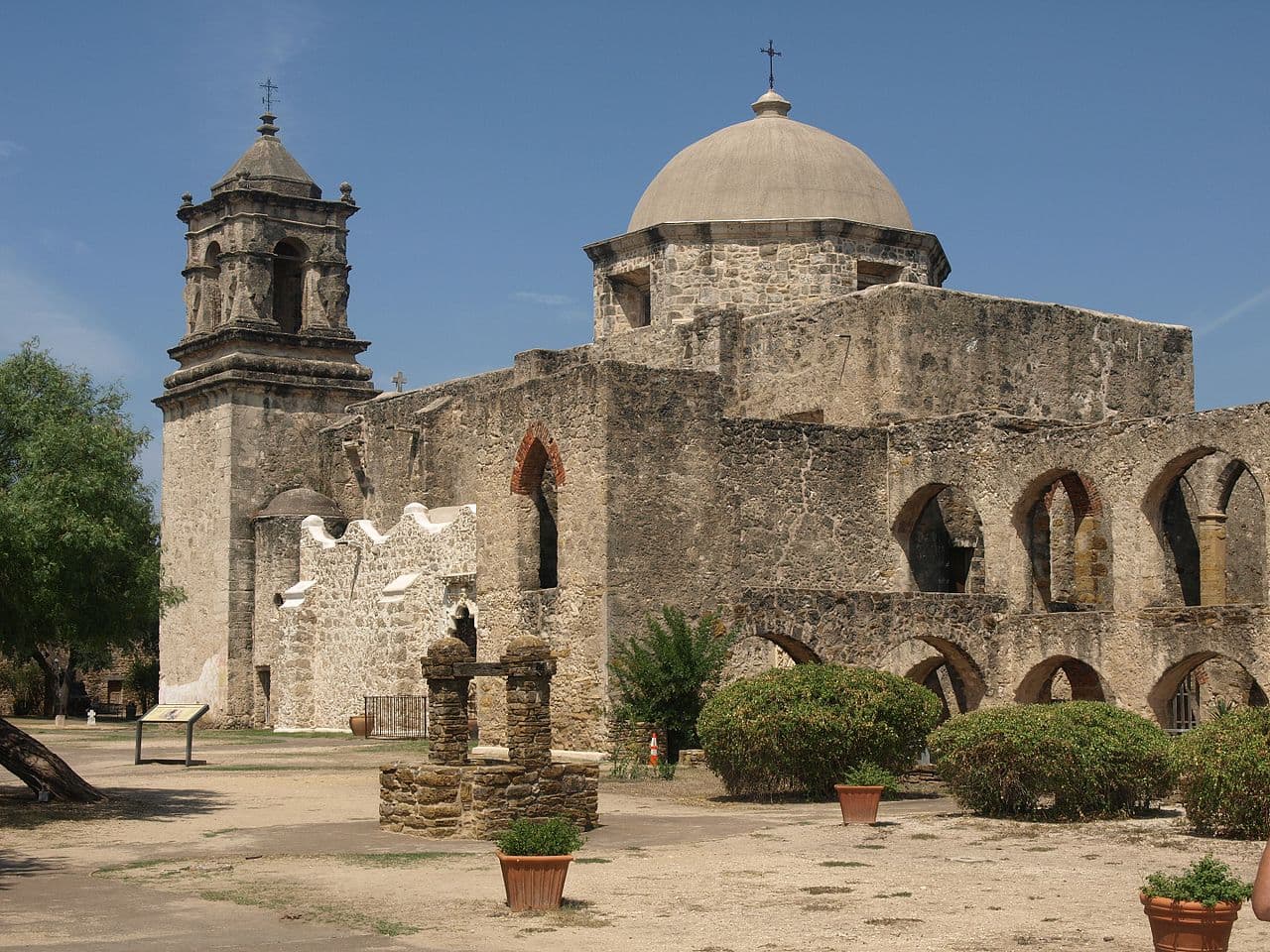
Gillfoto, CC BY-SA 4.0, via Wikimedia Commons
San Antonio Missions
Misiones de San Antonio
Also known as: San Antonio Missions National Historical Park, Texas Spanish Missions
Religions: Roman Catholic | Place Type: Religious complex | Region: North America | UNESCO World Heritage Site
Overview
The San Antonio Missions are a group of five Spanish colonial frontier mission complexes along the San Antonio River in San Antonio, Texas, designated as a UNESCO World Heritage Site in 2015. Built by Franciscan missionaries between 1718 and 1731, the missions—Mission San Antonio de Valero (the Alamo), Mission Concepción, Mission San José, Mission San Juan, and Mission Espada—represent the most complete surviving examples of Spanish colonial missions in North America. Four missions (excluding the Alamo) comprise San Antonio Missions National Historical Park, managed by the National Park Service, while all five function as active Catholic parishes. The missions illustrate the Spanish Crown's colonization strategy combining religious conversion, agricultural development, and territorial control. They showcase 18th-century architecture, irrigation systems, and the blending of Spanish and indigenous cultures. The site marks the only UNESCO World Heritage Site in Texas and attracts over 1 million visitors annually.
Present
San Antonio Missions National Historical Park operates through a unique partnership: the National Park Service manages the historic sites while the Catholic Archdiocese of San Antonio owns the churches and conducts religious services. This arrangement allows the missions to function simultaneously as active parishes, protected historical sites, and public educational resources.
Regular Masses are celebrated at all four missions, along with baptisms, weddings, funerals, and feast-day observances. Visitors are welcome to attend services and observe Catholic worship taking place in historic churches that remain in active use.
Outside of service times, visitors may enter the mission churches and walk the surrounding grounds. Some missions, particularly San Juan and Espada, are quieter and less visited, offering a more secluded setting. The mission churches retain original or minimally restored interiors, including religious artwork and architectural features designed for Catholic liturgy.
The four missions are connected by the Mission Reach Trail, allowing visitors to walk or cycle between them along the San Antonio River. This provides access to multiple churches within a single historic religious landscape.
The missions host ongoing religious and cultural events, including patron-saint feast days and liturgical celebrations. Conservation work continues alongside religious use, maintaining the churches as functioning sacred spaces rather than solely museum sites.
Religious Significance
Roman Catholicism
For Roman Catholics, the San Antonio Missions hold religious significance as sites where Franciscan missionaries worked to convert indigenous peoples to Catholicism and integrate them into Spanish colonial society during the 18th century. The mission system represented Spain's colonization method in the Americas: missions served as religious, agricultural, and defensive outposts where Franciscan friars (members of the Order of Friars Minor, followers of St. Francis of Assisi) aimed to convert Native Americans, teach European agricultural and craft techniques, and claim territory for the Spanish Crown. Indigenous groups, including Coahuiltecan peoples and the Payaya, were baptized, instructed in Catholic doctrine, and incorporated into mission communities centered on daily worship, sacraments, and the Catholic liturgical calendar.
The mission system has been both lauded and criticized. Supporters view missions as providing spiritual salvation, protection from hostile groups, and agricultural/technical education. Critics note missions disrupted indigenous cultures, coerced conversion and labor, confined people within mission systems, exposed populations to European diseases (which decimated indigenous groups), and enabled Spanish colonialism. Historical truth encompasses both perspectives: missions provided community and resources for some indigenous people while destroying traditional lifeways and autonomy for others.
The mission system declined in the late 18th-early 19th centuries. Spanish colonial authorities secularized missions (transferring them from church to civil control) as part of reforms. Indigenous populations had declined drastically due to disease, and those remaining had been largely Christianized and Hispanicized. Missions transferred to diocesan (regular parish) control. By the 1820s-1830s, following Mexican independence from Spain (1821), missions were fully secularized and often abandoned. Many fell into ruins.
Today, all five San Antonio missions function as active Catholic parishes within the Archdiocese of San Antonio. Regular Masses are celebrated, and local Hispanic and Anglo communities worship at these historic churches. The missions represent living faith traditions connecting contemporary Catholics to 300 years of religious history. For many San Antonio families, especially those of Mexican and indigenous heritage, the missions are ancestral sites where forebears were baptized, married, and buried. The missions embody the complex legacy of Spanish colonization—sites of faith, cultural transformation, and contested history.
History & Structure
The San Antonio Missions were founded between 1718 and 1731 as part of Spain’s effort to colonize Texas and secure territory along the San Antonio River. Mission San Antonio de Valero (the Alamo) was established first, followed by four additional missions relocated from East Texas. Together, they formed a chain of religious and agricultural settlements serving colonial and missionary purposes.
Each mission was organized around a church and fortified compound, with living quarters, workshops, farmland, and acequia irrigation systems that enabled self-sufficiency. Built primarily of local limestone, the missions combine Spanish colonial architecture with Indigenous craftsmanship, including baroque decorative elements.
By the late 18th and early 19th centuries, disease, conflict, and secularization led to the decline of the mission system. After Mexican independence, many structures deteriorated or were repurposed, while the Alamo became a focal point during the 1836 Texas Revolution. The remaining missions later resumed their role as parish churches. Preservation efforts in the 20th century led to their protection as historic sites, and in 2015 all five missions were designated a UNESCO World Heritage Site, recognizing them as a unified cultural landscape of Spanish colonial settlement.
Practical Information
- Access
- Open access to all visitors. Each mission has its own parking lot. VIA bus Route 42 serves all four missions.
- Accessibility
- Accessible parking, ramps, and restrooms at all missions. Churches and visitor areas wheelchair accessible. Some uneven stone or gravel paths. Mission Reach Trail fully paved and accessible.
- Accommodation
- Wide range in San Antonio. Downtown hotels, budget chains near missions, B&Bs. Book early during major events.
- Admission
- Free for all missions and visitor center. Donations welcome.
- Best times in the day
- Early morning or late afternoon to avoid heat and crowds. Weekdays quieter.
- Best Times of the year
- October–April for mild weather. Summer very hot; plan early or late visits.
- Dress Code
- Casual but respectful. Modest attire recommended inside churches.
- Etiquette
- Quiet voices inside churches, modest dress, no food or drink indoors, respectful behavior during worship. Avoid loud conversation, do not disrupt religious activities.
- Events
- World Heritage Festival (September), living history demonstrations, patron saint feast days, Fiesta San Antonio (April).
- Getting Around
- Car (most flexible), VIA bus Route 42 (budget), bicycle via Mission Reach Trail, or guided tours.
- Getting There
- - From San Antonio International Airport (SAT): 20–40 minutes by car - Downtown San Antonio: 5–15 minutes by car - VIA Route 42 connects downtown to all missions - Bike via Mission Reach Trail (8 miles)
- Guided Tours
- Free ranger-led tours at Mission San José (daily, times vary). Audio tours via NPS app.
- Hours
- Park grounds open daily 09:00–17:00. Churches open outside Mass times. Visitor Center at Mission San José open daily 09:00–17:00 (film hourly 10:00–16:00).
- Language
- English and Spanish widely spoken. Bilingual signage and rangers.
- Location
- Along the San Antonio River, 2–10 miles south of downtown San Antonio, Texas. - Mission Concepción: 807 Mission Road - Mission San José: 6701 San José Drive - Mission San Juan: 9101 Graf Road - Mission Espada: 10040 Espada Road (The Alamo is downtown at 300 Alamo Plaza, managed separately.)
- Meditation
- Quiet corners at Mission San Juan and Espada especially suitable for reflection.
- Photography
- Allowed throughout grounds and churches (no flash during Mass). Best light early morning or late afternoon.
- Restrictions
- No drones without permit. Respect Mass times, do not interrupt services.
- Security
- Park rangers present. Generally safe; standard urban precautions apply.
- Tickets
- None required.
- What to Bring
- Water, sunscreen, hat, comfortable shoes, camera, bike helmet (if cycling).