
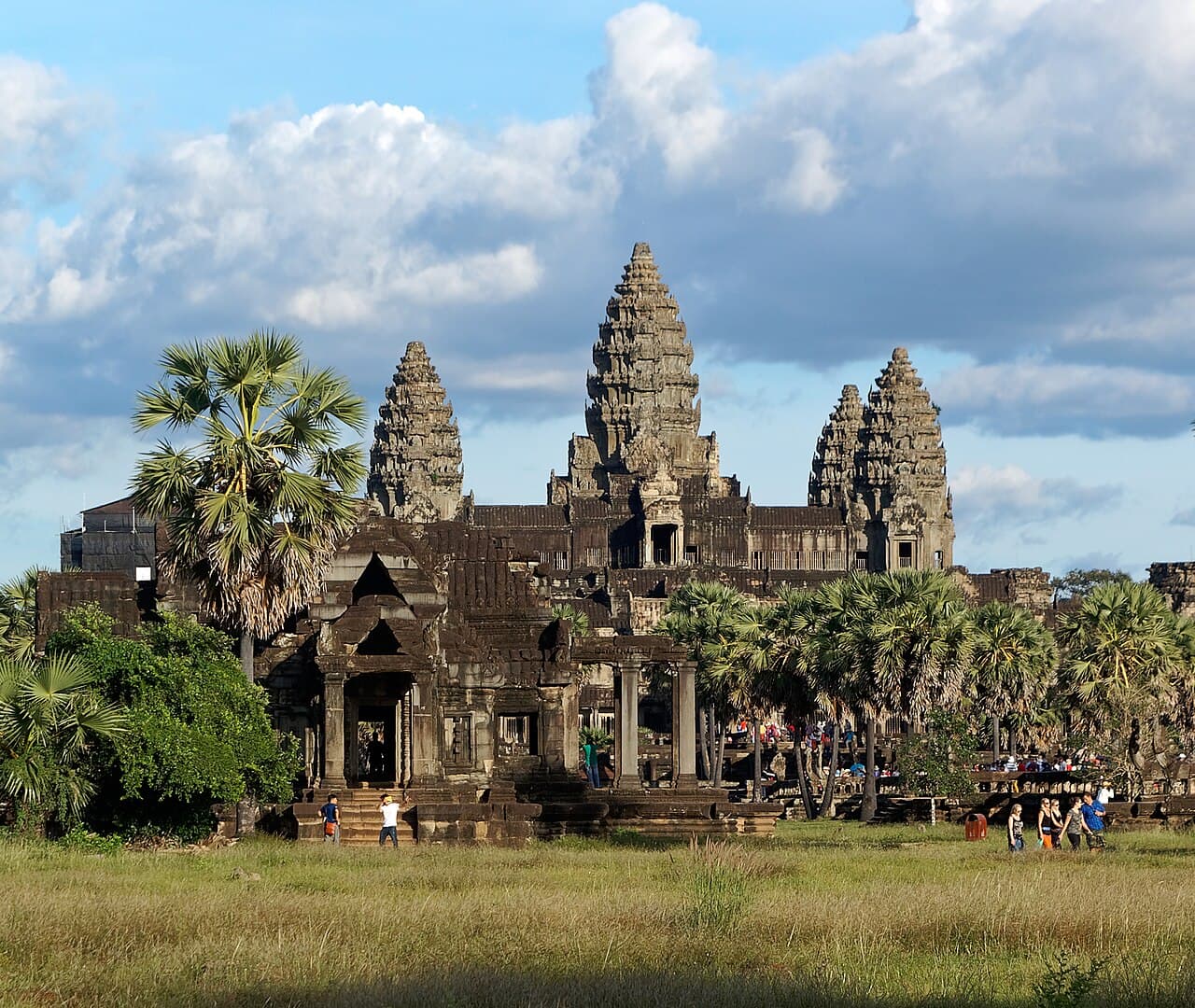
Jakub Hałun, CC BY-SA 4.0, via Wikimedia Commons
Angkor Wat
អង្គរវត្ត (Ângkôr Vôtt)
Also known as: Angkor Vat, City Temple
Religions: Hinduism, Buddhism | Place Type: Temple | Region: Asia | UNESCO World Heritage Site
Overview
Angkor Wat is the world's largest religious monument, located in Siem Reap, Cambodia. Built in the 12th century as a Hindu temple dedicated to Vishnu, it gradually transformed into a Buddhist temple and remains an active center of worship. The temple complex appears on Cambodia's national flag and is the country's most iconic symbol.
Present
Angkor Wat receives over two million visitors annually and is Cambodia's most important tourist attraction. The site is managed by the Authority for the Protection and Management of Angkor and the Region of Siem Reap (APSARA), established in 1995. Active Buddhist worship continues with resident monks.
Conservation challenges include structural stability concerns from underground water table issues due to tourism development, graffiti damage, and balancing tourism growth with preservation. In 2012, Angkor Wat and Borobudur in Indonesia became sister sites. The temple complex appears prominently on Cambodia's national flag.
Religious Significance
Hinduism
Originally built as a state temple dedicated to Vishnu, one of the three principal gods in Hinduism. Vishnu is known as the "Protector" and appears to humans in many forms (avatars) to guide and instruct people. The temple's five central towers symbolize the peaks of Mount Meru, the dwelling place of the gods in Hindu mythology. Extensive bas-reliefs depict Hindu epics including the Ramayana and the Mahabhata, and most famously the Churning of the Ocean of Milk, a creation story about the beginning of time and the victory of good over evil. The temple was intended as King Suryavarman II's state temple and mausoleum.
Buddhism
Although originally built as a Hindu temple, Angkor Wat gradually transitioned into a Buddhist site starting in the late 13th century. This shift was largely influenced by King Jayavarman VII, who dedicated the empire to Buddhism after the capital was attacked by the neighboring Cham people in 1177. Buddhist statues and artwork were added while original Hindu elements were preserved, creating a rare site where both traditions coexist. Today, it remains a vital pilgrimage shrine where monks reside and meditate. During the Vesak (Waicak) festival, thousands of saffron-robed monks lead processions to commemorate the Buddha’s birth, enlightenment, and passing.
History & Structure
Angkor Wat was built between 1113 and 1150 CE by King Suryavarman II as the state temple of the Khmer capital. Originally a Hindu temple dedicated to Vishnu, it is unusually oriented westward other than most Angkorian temples which are oriented to the east, in alignment with sunrise and traditional Hindu cosmology. Construction was extensive but never fully completed.
In the late 13th century, the temple gradually transitioned to Buddhist use while retaining its Hindu architecture and imagery. Although Angkor later ceased to function as a capital and the site suffered damage from earthquakes and conflict, Angkor Wat was never fully abandoned and remained in continuous religious use.
French explorer Henri Mouhot brought international attention to the site in the 1840s. It was designated a UNESCO World Heritage Site in 1992.
Modern Period: The Khmer Rouge used the area during Cambodia's civil war in the 1970s, causing some damage (bullet holes remain on outer walls). UNESCO designated it a World Heritage Site in 1992, initially listing it as "in danger" but removing this designation in 2004 after restoration efforts increased.
Practical Information
- Admission
- One-day pass $37, three-day pass $62, seven-day pass $72 (2024 prices). Tickets must be purchased at the Angkor ticket office; passes include photos.
- Best Time
- Sunrise and sunset are most popular but crowded. October-March offers cooler weather during dry season. Avoid peak summer heat (March-May).
- Dress Code
- Respectful dress required - shoulders covered, knee-length shorts or longer. Shoes must be removed in some areas.
- Getting There
- 20-minute drive from Siem Reap. Options include tuk-tuks, private cars with driver, bicycle, or organized tours.
- Hours
- Daily 5:00 AM-5:30 PM; open 24 hours during major Buddhist festivals.
- Location
- 5.5 km north of Siem Reap town, Cambodia.
- Tips
- Start early to beat crowds and heat. Bring water, sunscreen, and hat. The complex is vast (162.6 hectares) - allocate at least half a day, preferably a full day. Guides available at entrance can enhance understanding of bas-reliefs and symbolism.