
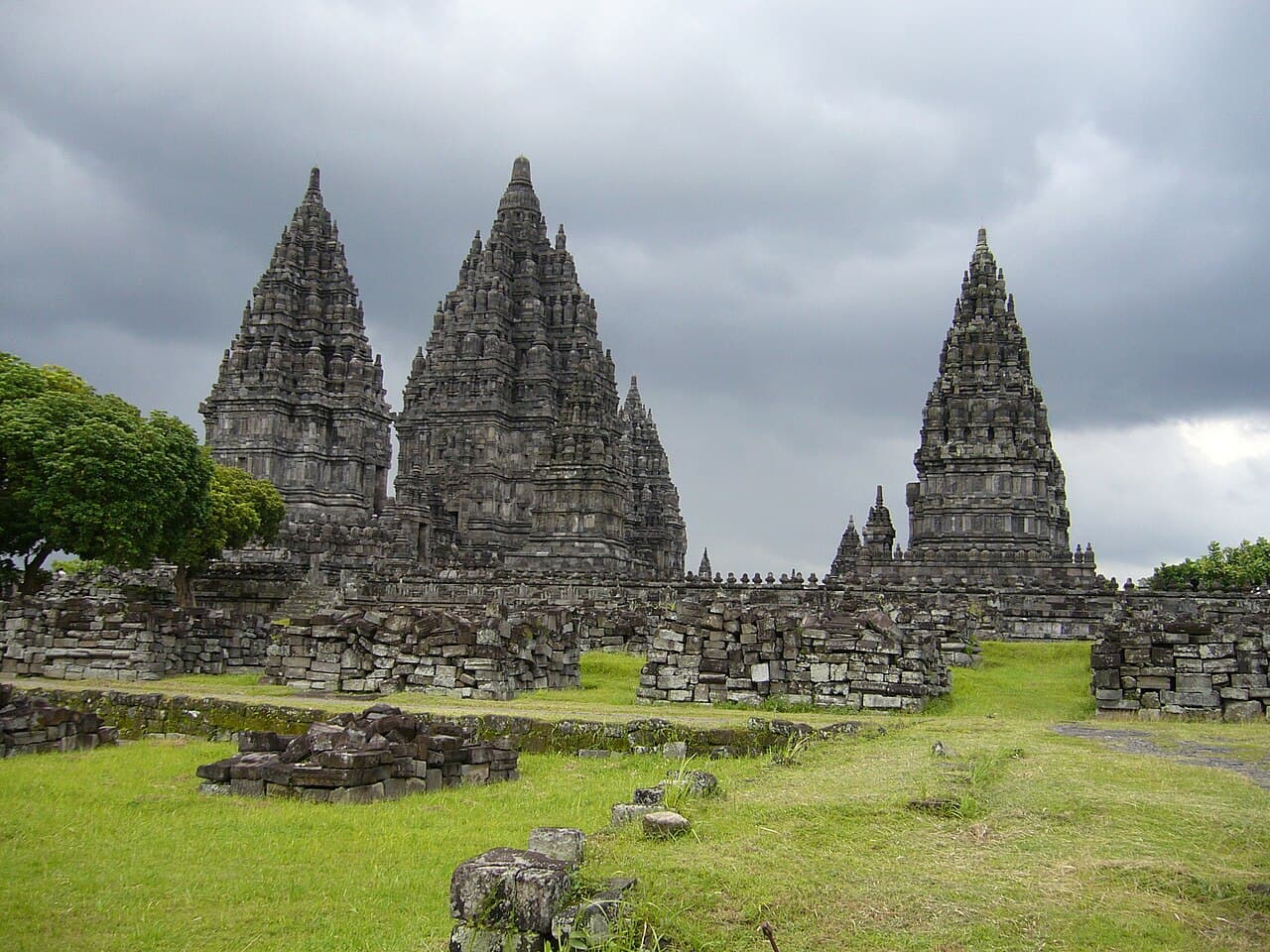
Giovanni Boccardi, CC BY-SA 3.0 igo, via Wikimedia Commons
Prambanan Temple Compounds
Candi Prambanan
Also known as: Loro Jonggrang, Rara Jonggrang
Religions: Hinduism | Place Type: Temple | Region: Asia | UNESCO World Heritage Site
Overview
Prambanan is the largest Hindu temple complex in Indonesia and the second-largest in Southeast Asia after Angkor Wat. Located in Central Java near Yogyakarta, this 9th-century temple compound is dedicated to the Trimurti - the three great Hindu gods Brahma, Vishnu, and Shiva.
Present
Prambanan is managed jointly by the Archaeological Survey of Indonesia and Borobudur, Prambanan and Ratu Boko Tourism Park Ltd. The site received approximately 2-3 million visitors annually before the pandemic.
Since the 1990s reconstruction active Hindu worship resumed with annual ceremonies, and Prambanan has been reclaimed as an important religious center. Balinese and Javanese Hindu communities perform annual sacred ceremonies including Galungan, Tawur Kesanga, and Nyepi festivals.
The nearby open-air Prambanan theater hosts traditional Ramayana ballet performances during full moon nights, a tradition since the 1960s.
Religious Significance
Hinduism
Prambanan is dedicated to the Trimurti, representing the three supreme aspects of the divine in Hinduism:
Shiva (The Destroyer)
The central and tallest temple (47 meters) is dedicated to Shiva Mahadeva. The inner sanctum contains a large four-armed statue of Shiva standing on a lotus throne, with additional chambers dedicated to Durga (Shiva's consort, shown slaying the buffalo demon), Agastya (a revered sage), and Ganesha (Shiva's elephant-headed son). The southern chamber houses Batara Guru, considered an avatar of Shiva in Javanese Hinduism who gives prophecy and presents.
Vishnu (The Preserver)
The northern main temple is dedicated to Vishnu. Its walls feature carvings depicting battles of Krishna, an avatar of Vishnu, from the Bhagavata Purana.
Brahma (The Creator)
The southern temple is dedicated to Brahma. Its reliefs depicting the Ramayana epic, showing Prince Rama’s journey to rescue his wife, Sita, from the demon king Ravana. These reliefs illustrate the victory of dharma (righteousness) over evil. They are designed to be read in a clockwise direction during circumambulation (pradakshina), a Hindu devotional practice.
Vehicle Temples
Three smaller temples face the main temples, dedicated to each god's vehicle (vahana): Nandi (Shiva's sacred bull), Garuda (Vishnu's bird-like creature), and Hamsa (Brahma's goose or swan). A life-sized statue of Nandi sits in front of Shiva's temple.
History & Structure
Built around 850 CE by Rakai Pikatan, Prambanan served as the royal temple of the Hindu Mataram Kingdom. Its construction marked a shift back to Hindu patronage in Central Java after decades of Buddhist dominance. At its peak, the complex contained 240 structures and housed hundreds of Hindu priests and scholars.
The temple's design features a central tower that was the tallest in ancient Java. Locally, the site is also known as Rara Jonggrang after a legend about a princess who was turned to stone and became the temple's statue of the goddess Durga.
Following the kingdom’s relocation to East Java in the 10th century, the site was gradually abandoned. A major earthquake in the 16th century caused the central structures to collapse, leaving the temple in ruins until modern restoration efforts began.
Major reconstruction of the main temples occurred in the 1930s-1950s. The three main temples were rebuilt by 1953. A 6.3 magnitude earthquake on May 27, 2006, severely damaged the temple complex. The Shiva temple alone had 479 blocks collapse or crack. Restoration work continued for several years.
The site was designated a UNESCO World Heritage Site in 1991 as part of "Prambanan Temple Compounds" which includes Sewu, Lumbung, and Bubrah Buddhist temples.
Practical Information
- Admission
- Domestic visitors: IDR 50,000. Foreign visitors: IDR 350,000 (approximately $22-25 USD). Combination tickets available with Borobudur. Ramayana ballet: separate tickets starting from IDR 100,000.
- Best Time
- Early morning (6:00-9:00 AM) or late afternoon (3:00-5:00 PM) to avoid heat and crowds. Dry season (April-October) is most popular. Ramayana performances best during full moon.
- Dress Code
- Respectful dress recommended. No specific restrictions but modest clothing appropriate for a religious site.
- Getting There
- From Yogyakarta city: Trans Jogja bus 1A from various points including airport and city center (IDR 3,600), private taxi/Grab (30-40 minutes), or organized tour. DAMRI buses from Bank Indonesia in city center.
- Hours
- Daily 6:00 AM-5:00 PM. Ramayana ballet performances (dry season, May-October): Tuesday, Thursday, Saturday evenings 7:30 PM-9:30 PM.
- Location
- 17 km northeast of Yogyakarta city center, Central Java, Indonesia. Located on the border between Yogyakarta and Central Java provinces, near the village of Prambanan.
- Nearby Sites
- Ratu Boko palace (3 km south).
- Photography
- Photography permitted.
- Tips
- - Allow 2-3 hours to explore main temples and immediate grounds, full day if exploring outer temple ruins. - Free map and bottled water included with foreign ticket. - Guides available at entrance. - Bring sunscreen, hat, and water.