
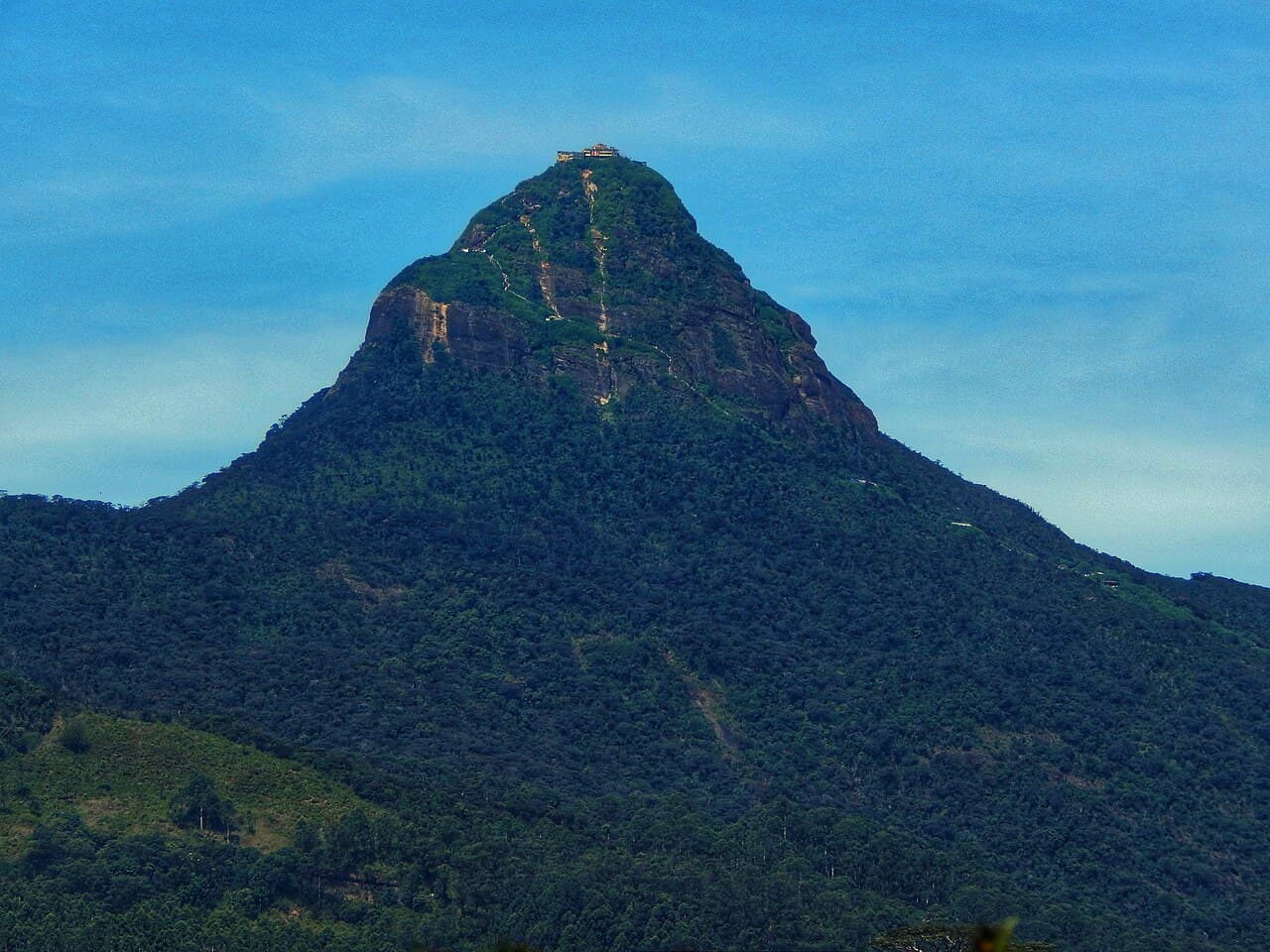
Jithey, CC BY-SA 4.0, via Wikimedia Commons
Adam's Peak
ශ්රී පාද (Sri Pada)
Also known as: Sri Pada, Sri Pada Mountain, Samanala Kanda, Mount Malaya, Shivanolipatha Malai, Sivan Adi Padham
Religions: Buddhism, Hinduism, Islam, Christianity | Place Type: Mountain | Region: Asia
Overview
Adam's Peak, known as Sri Pada in Sinhala, is a 2,243-meter (7,359-foot) conical mountain in central Sri Lanka. It is one of the world's most remarkable pilgrimage destinations, held sacred by followers of four major religions: Buddhism, Hinduism, Islam, and Christianity. The summit features a 1.8-meter rock formation resembling a footprint, which different faith traditions attribute to the Buddha, Shiva, Adam, or St. Thomas respectively.
Present
Adam's Peak continues to be one of Sri Lanka's most important pilgrimage sites, attracting approximately 20,000-30,000 pilgrims annually.
The Peak Wilderness Sanctuary, established in 1940 as a conservation zone, protects 224 square kilometers of rainforest surrounding the mountain, home to elephants, leopards, and endemic species. Conservation efforts balance pilgrimage traditions with environmental protection.
The distinctive triangular shadow that the conical peak casts at sunrise (visible when viewed from the summit looking west) is considered a spiritual phenomenon, moving rapidly down the plain as the sun rises—a sight that draws many pilgrims to time their summit arrival for dawn.
Religious Significance
Buddhism
For Buddhists, the footprint (Sri Pada, meaning "sacred footprint") was left by Buddha during his third and legendary final visit to Sri Lanka in the 6th century BCE. According to the Mahawamsa chronicle, the Buddha was invited by Saman, a deity who became the mountain's guardian god (Maha Sumana Saman). The Buddha is said to have left his footprint on a giant sapphire at the summit as a symbol for worship. Sri Lankan Buddhists consider the footprint one of the most sacred Buddhist relics in the country. The pilgrimage season (December-May) sees tens of thousands of Buddhist devotees making the arduous nighttime climb, many hoping to reach the summit for sunrise, chanting "Sadhu! Sadhu!" (Well done!) as encouragement.
Hinduism
Tamil Hindus believe the footprint belongs to Shiva, who left it while performing his cosmic dance of creation. They call the mountain Shivanolipatha Malai ("Mountain of Shiva's Luminous Footprint") or Sivan Adi Padham ("Shiva's Sacred Foot"). Some Hindu traditions also associate the peak with Hanuman from the Ramayana epic, believing it to be Mount Trikuta, capital of the demon king Ravana who ruled ancient Lanka.
Islam
Muslims believe the footprint was left by Adam (considered a prophet in Islam) when he was expelled from the Garden of Eden and first set foot on Earth. Islamic tradition holds that God placed Adam here because Sri Lanka was the closest place on earth to paradise. According to legend, Adam stood on one foot for a thousand years in penance for his transgression, leaving the massive footprint impression. Some Arab writings refer to the mountain as "Al-Rohun" (The Soul).
Christianity
Some Christian traditions, particularly among Portuguese Catholics who arrived in the 16th century, claim the footprint belongs to St. Thomas the Apostle, who is credited with bringing Christianity to southern India and Sri Lanka in the 1st century CE. Other Christian interpretations also attribute it to Adam.
Pre-Buddhist Worship
Before Buddhism arrived in Sri Lanka, the indigenous Vedda people worshipped the mountain as Samanala Kanda, venerating Saman as a protective deity.
History & Structure
Historical references to the sacred mountain appear in ancient chronicles. The Mahawamsa (5th century CE) records Buddha's visit and King Valagamba's 1st century BCE refuge on the mountain while fleeing invaders. An Ambagamuwa rock inscription documents King Vijayabahu I's (1058-1114 CE) personal ascent to worship the footprint. The Chinese Buddhist pilgrim Fa Hien stayed in Sri Lanka 411-412 CE and mentioned Sri Pada, though whether he climbed it remains unclear.
Marco Polo's 1298 Travels noted Adam's Peak as an important pilgrimage site but did not specifically mention the footprint. Regular documented pilgrimages began in the 11th century, with King Vijayabahu I encouraging villages along routes to provide support for pilgrims. The mountain became a major destination for Buddhist pilgrims from throughout Asia. Arab seafarers were fascinated by the pyramid-shaped peak visible from the ocean and exaggerated its height in medieval writings. Some accounts claimed the mountain was the world's highest (it is actually Sri Lanka's 5th tallest) and "visible from three days sail."
Pilgrimage Routes: Access paths were established over centuries. The most dramatic route features steep sections secured with chains, traditionally attributed to Alexander the Great, though there's no evidence he reached Sri Lanka. The chains assist pilgrims ascending nearly vertical rock faces.
Summit Structures: The summit platform (74 x 24 feet) houses a small Buddhist temple and the shrine of Saman protecting the sacred footprint. A bell allows pilgrims to ring it once for each successful pilgrimage. The mountain is also called "butterfly mountain" (Samanalakande) because millions of small butterflies migrate there annually, dying at the peak—a phenomenon that has inspired spiritual interpretations about souls seeking the sacred mountain.
Practical Information
- Accommodation
- Hatton and Ratnapura offer guesthouses (LKR 2,000-5,000). Some pilgrims stay at mountain rest houses partway up (basic, crowded during season).
- Cultural Sensitivity
- Respect all religious traditions. Pilgrims of different faiths climb together peacefully—this multifaith harmony is part of the site's significance.
- Getting There
- The two main routes are from Ratnapura (Palabaddala route) and Hatton-Nallathanni (Dalhousie route). From Colombo to Ratnapura: bus (3 hours, LKR 400). From Colombo to Hatton: train (scenic, 4-5 hours) or bus (3 hours). Most pilgrims use Hatton/Dalhousie route (shorter, better facilities). From Hatton/Dalhousie to trailhead: tuk-tuk or taxi.
- Photography
- Photography of footprint area varies by season. **Climbing:** Start late afternoon/evening to summit for sunrise. Hatton route: 7 km, 5,500+ steps, 5-7 hours ascent, 3-4 hours descent. Ratnapura route: longer, more strenuous. The trail has lit concrete steps, tea shops, rest areas during season. Allow full day: afternoon start, overnight climb, sunrise, descent by midday.
- Pilgrimage Season
- December (full moon) through May (full moon), with special ceremonies. Best months: January-March. Avoid weekends, full moon days (Poya), and Sri Lankan New Year (mid-April) when trails are overcrowded. Off-season (June-November monsoon), the mountain remains accessible but conditions are dangerous with heavy rain, mist, and reduced facilities.
- Temple Etiquette
- Remove shoes before entering summit temple. Respectful clothing. Silent contemplation.
- What to Bring
- Warm layers (summit temperature 5-10°C even when valleys are hot), rain jacket, comfortable hiking shoes, headlamp/flashlight, water, snacks, cash (no cards accepted on mountain). Some pilgrims climb barefoot for spiritual reasons.