
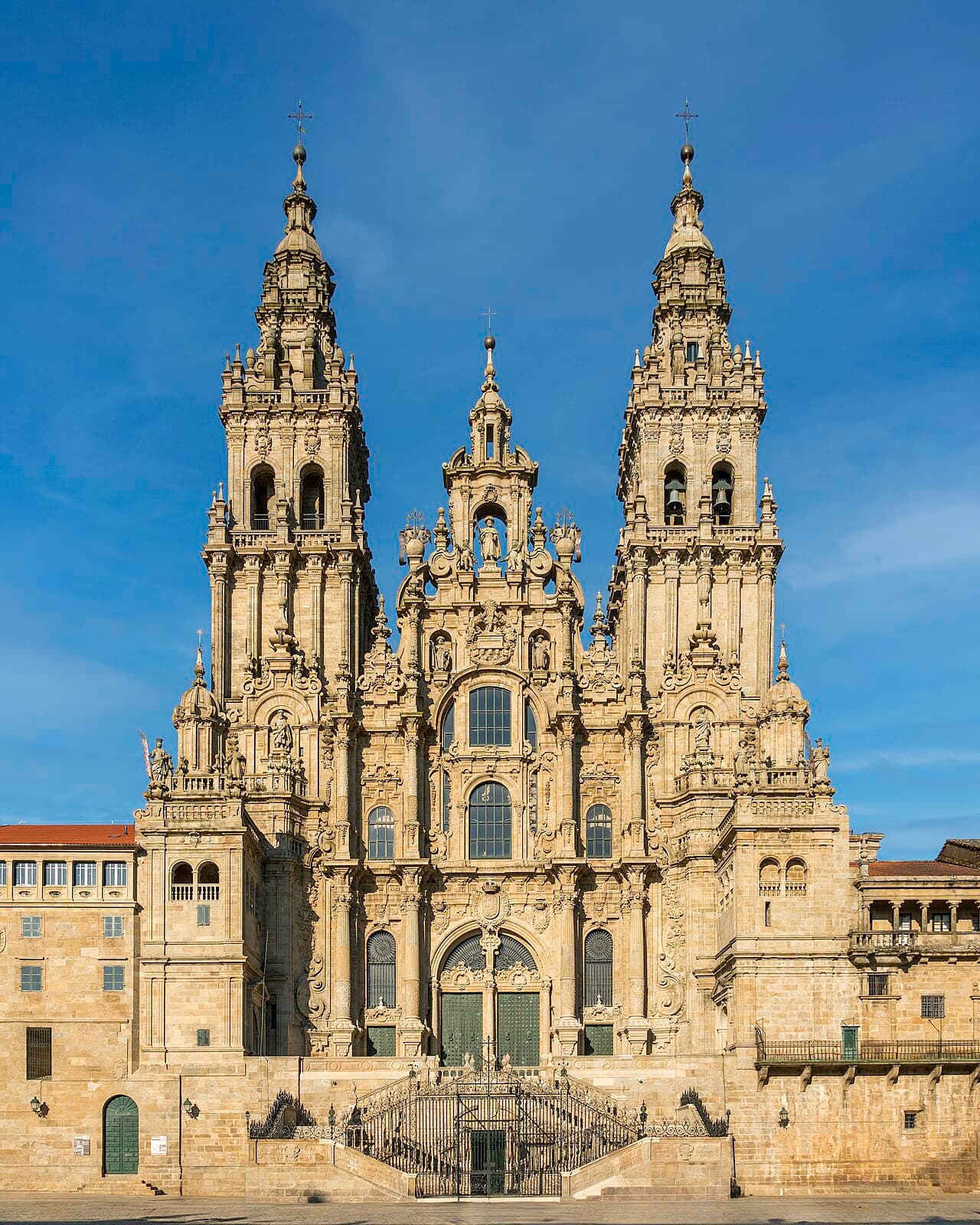
Fernando, CC BY-SA 4.0, via Wikimedia Commons
Santiago de Compostela Cathedral
Catedral de Santiago de Compostela
Also known as: Cathedral of Saint James, Catedral Basílica de Santiago de Compostela
Religions: Christianity | Place Type: Cathedral | Region: Europe | UNESCO World Heritage Site
Overview
The Santiago de Compostela Cathedral is a Roman Catholic cathedral in Galicia, northwestern Spain, believed to house the tomb of Saint James the Great, one of Jesus's twelve apostles. The cathedral is the culmination point of the Camino de Santiago (Way of St. James), a network of medieval pilgrimage routes crossing Europe that made Santiago one of Christianity's three most important pilgrimage cities alongside Jerusalem and Rome. This UNESCO World Heritage Site attracts hundreds of thousands of pilgrims and visitors annually.
Present
Santiago de Compostela Cathedral functions as the seat of the Archbishop of Santiago de Compostela and an active place of Catholic worship conducting daily masses. The cathedral museum (separate admission) displays religious art, tapestries, the cathedral's archaeological crypt showing foundations of earlier churches, and the cathedral library containing historic manuscripts. The tomb of St. James is located in the crypt beneath the main altar; pilgrims descend to venerate the silver casket containing relics.
The cathedral archive maintains extensive records of pilgrims dating back centuries. The adjacent Pilgrim's Office issues Compostela certificates (in Latin) to pilgrims who present stamped credential booklets proving they walked the requisite distance. The office sees 200,000-400,000 pilgrims annually depending on whether the year is a Holy Year.
The cathedral underwent extensive restoration 2007-2021, during which the main facade was covered in scaffolding but the cathedral remained open for worship.
The cathedral bells ring throughout the day, with the largest bell (17th century) weighing 9,600 kg. The roof and tower tours (separate tickets) offer views over the city and explain the cathedral's construction and symbolism. The cathedral complex includes cloisters, chapter house, treasury, and the monumental staircase connecting upper and lower levels of Praza do Obradoiro.
Religious Significance
Roman Catholicism
The cathedral's religious significance centers on the belief that Saint James the Great (in Spanish: Santiago), son of Zebedee and brother of John the Evangelist, is buried here. According to Christian tradition, James preached Christianity in Iberia (modern Spain and Portugal) before returning to Jerusalem where King Herod Agrippa I martyred him around 44 CE, making James the first apostle martyred. Legend recounts that James's disciples transported his body by boat to Galicia and buried him in a secret location that was lost for centuries.
In 813 CE, a hermit named Pelayo reportedly witnessed strange lights and heard angelic music in a field. Bishop Theodomir of Iria Flavia investigated and discovered a tomb identified as James's burial place. King Alfonso II of Asturias declared the site authentic and ordered a church built, establishing Santiago de Compostela ("Santiago" = Saint James, "Compostela" possibly from Latin "campus stellae" meaning "field of stars," referencing the hermit's vision). The discovery occurred during the Christian Reconquista (reconquest of Iberian Peninsula from Muslim Moors), and St. James became Spain's patron saint and a symbol of Christian military resistance. Images of "Santiago Matamoros" (St. James the Moor-slayer) depicted the saint on horseback in battle, though this militant imagery contrasts with pilgrimage's spiritual nature.
The Camino de Santiago developed from the 9th-10th centuries onwards as pilgrims from across Europe walked to venerate James's relics. During medieval Christianity's peak (11th-13th centuries), Santiago attracted 500,000+ pilgrims annually, becoming Europe's greatest pilgrimage after Rome and Jerusalem. Pilgrims who completed the journey received a scallop shell symbol, still the Camino's emblem.
The pilgrimage declined after the Reformation but revived in the 20th-21st centuries; in 2021 (a Holy Year when July 25 falls on Sunday), over 400,000 pilgrims completed the Camino. Today pilgrims walk for religious, spiritual, cultural, athletic, or personal reasons. The traditional pilgrimage minimum is the final 100 km walking (or 200 km cycling) to earn the Compostela certificate from the Pilgrim's Office.
The daily Pilgrim's Mass at noon includes the Botafumeiro ceremony (when sufficient donations are received): eight men swing a massive 80 kg incense burner on ropes across the transept, reaching speeds of 68 km/h—originally to mask pilgrims' odor after long journeys, now a spectacular tradition. The main altar houses a wooden statue of St. James; pilgrims traditionally climb stairs behind the altar to embrace the statue.
History & Structure
The first church at this site was constructed between 829 and 899 CE over the discovered tomb of St. James. Following its destruction in 997 CE, the current cathedral was begun in 1075 and largely completed by 1211, with further additions made in the following centuries.
A central feature of the interior is the Pórtico de la Gloria, completed in 1188 and containing over 200 figures depicting the Last Judgment. Traditionally, pilgrims placed their hands in an indentation on the central column, a practice that has worn a deep groove into the stone over centuries of devotion. The cathedral faces the Praza do Obradoiro, a square flanked by historic structures including a 15th-century pilgrims' hospital.
The site houses several significant chapels and the Holy Door (Porta Santa), which remains sealed except during Holy Years—occurring when the feast day of St. James (July 25) falls on a Sunday. The next Holy Years are scheduled for 2027 and 2032. Both the cathedral and its associated pilgrimage routes are recognized as UNESCO World Heritage sites for their enduring cultural and religious importance.
Practical Information
- Accommodation
- Santiago has hostels, guesthouses (€15-50), hotels (€50-150). Book ahead during Holy Years and summer. Pilgrim albergues (hostels) throughout city (€10-15).
- Best times in the day
- Avoid July-August (extreme crowds, heat). Spring (April-May) and autumn (September-October) ideal. Winter quiet but cold, rainy.
- Camino Routes
- Multiple routes exist; most popular is Camino Francés from St-Jean-Pied-de-Port, France (800 km, 30-35 days walking). Other routes: Portuguese Way, Northern Way, English Way, Primitive Way. Minimum 100 km walking or 200 km cycling to receive Compostela certificate.
- Dress Code
- Respectful clothing covering shoulders and knees for mass and accessing altar/tomb.
- Getting Around
- Most pilgrims arrive on foot or bicycle via Camino routes.
- Getting There
- Santiago has an airport (SCQ) with flights from major European cities (Madrid, Barcelona, London, Paris, Frankfurt). From airport, bus to city center (25 minutes, €3). By train from Madrid (5-6 hours, €30-70), Barcelona (8-9 hours). ALSA buses connect to other Spanish cities. Most pilgrims arrive on foot or bicycle via Camino routes.
- Hours
- Open daily 07:00-21:00 for prayer. Tourist visits Monday-Sunday 10:00-20:00. Free entry to nave and chapels. Museum, rooftops, and Portico de la Gloria tour require separate tickets (€12-19 combo). Accredited pilgrims receive reduced admission.
- Location
- The cathedral is in Santiago de Compostela's historic center in Galicia, northwestern Spain. The Old Town is compact and walkable.
- Note
- Next Holy Years: 2027, 2032. Holy Years see double visitor numbers.
- Pilgrim's Mass
- Daily masses held at 07:30, 09:30, 12:00 (main), and 19:30. The noon mass is most important, with pilgrims named by nationality. Botafumeiro incense swinging not guaranteed daily (only major feast days and with prior donation). English mass at 10:30 daily except Wednesdays at Pilgrim Chapel. Free entry to mass.
- Pilgrim's Office
- Rúa Carretas 33 (near cathedral). Open daily 10:00-19:00 (longer in summer). Bring stamped credential (pilgrim passport). Compostela certificate free for religious pilgrims; distance certificate €3 for non-religious walkers. No large backpacks in cathedral. Pilgrims can leave bags at designated storage near Pilgrim's Office.
- Tickets
- Museum, rooftops, and Portico de la Gloria tour require separate tickets (€12-19 combo). Accredited pilgrims receive reduced admission.
- Tomb of St. James
- Located in crypt below main altar. Free access during cathedral hours. Expect queues.