
Berthold Werner, Public Domain, via Wikimedia Commons
Basilica of San Francesco
Basilica di San Francesco d'Assisi
Also known as: Papal Basilica of Saint Francis of Assisi, Basilica of Saint Francis
Religions: Roman Catholic | Place Type: Basilica | Region: Europe | UNESCO World Heritage Site
Overview
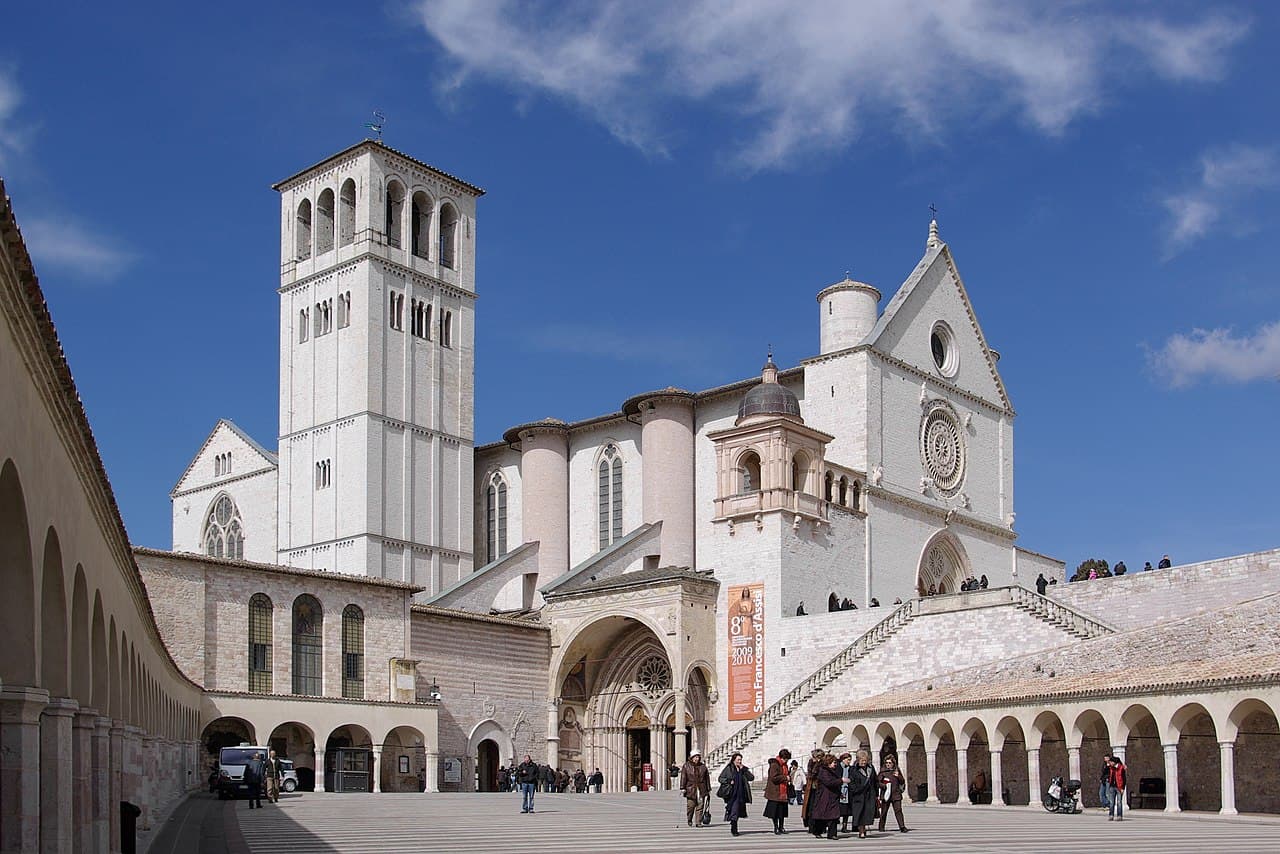
The Basilica of San Francesco in Assisi, Italy, is a Roman Catholic sanctuary built to house the tomb of St. Francis of Assisi (1182–1226), founder of the Franciscan order. The complex is constructed into a hillside and consists of two superimposed churches—the Lower Basilica and the Upper Basilica—along with a crypt containing the saint’s remains. It is recognized as a UNESCO World Heritage Site.
Present
The Basilica of San Francesco operates as an active Franciscan church administered by the Sacro Convento (Sacred Convent), the Franciscan friary adjacent to the basilica. Approximately 50 Franciscan friars live in the convent, maintaining the basilica, celebrating daily liturgies, and welcoming pilgrims. The basilica is open daily for worship and tourism. Four Masses are celebrated daily in various basilica chapels, with additional services on Sundays and feast days. Pilgrims attend services, pray in the crypt before Francis's tomb, and participate in Franciscan devotions. The basilica attracts over 5 million visitors annually, making it one of Italy's most visited religious sites. Pope John Paul II visited in 1986 for an interreligious prayer gathering, and Pope Benedict XVI visited in 2011. Pope Francis visited in October 2013, marking the first papal visit by a pope named Francis.
Conservation challenges include managing humidity affecting frescoes, controlling visitor impact, and maintaining structural stability in an earthquake-prone region.
The Franciscan friars offer spiritual direction and confession to pilgrims. They maintain daily liturgical life, and major feast days—especially October 4, the Feast of St. Francis—draw large numbers of pilgrims for special liturgies and processions. Assisi becomes a pilgrimage center during this feast, with the basilica as the focal point.
Religious Significance
Roman Catholicism
The Basilica of San Francesco holds profound significance as the burial place and memorial to St. Francis of Assisi, one of Christianity's most beloved saints and founder of the Franciscan order. St. Francis (born Giovanni di Pietro di Bernardone, 1182-1226) renounced his wealthy merchant family's fortune after a spiritual conversion and chose a life of radical poverty, preaching, and service to the poor. He founded the Order of Friars Minor (Franciscans) based on principles of poverty, humility, and devotion to Christ's teachings. Francis is known for his love of nature and animals, and his stigmata (wounds matching Christ's crucifixion wounds that appeared on his body in 1224). He was canonized (declared a saint) in 1228, just two years after his death, by Pope Gregory IX.
The Franciscan movement revolutionized medieval Christianity, emphasizing direct service to the poor rather than monastic isolation. The three main branches of Franciscans—Order of Friars Minor, Order of Friars Minor Conventual, and Order of Friars Minor Capuchin—continue worldwide ministry today with tens of thousands of friars. St. Francis is patron saint of Italy, animals, ecology, and merchants. The basilica serves as the mother church of the Franciscan order and attracts millions of Catholic pilgrims annually.
Pilgrims come to pray at Francis’s tomb, attend Mass, and venerate relics associated with his life, including his tunic and personal objects. The crypt, where his stone sarcophagus rests, is a focal point for prayer and devotion.
History & Structure
Pope Gregory IX laid the basilica's first stone on July 17, 1228, one day after canonizing Francis. The site chosen had been Assisi's execution ground, called Colle dell'Inferno (Hill of Hell), which Francis called "Colle del Paradiso" (Hill of Paradise) and requested as his burial place. Brother Elias, Francis's companion and successor as head of the Franciscan order, supervised construction. The Lower Basilica was completed and consecrated in 1230, when Francis's remains were transferred from the church of San Giorgio. To prevent theft, the body was hidden in a secret crypt; its location was forgotten and rediscovered only in 1818. The Upper Basilica was completed around 1253.
The site suffered damage over centuries from humidity, earthquakes, and 19th-century restoration attempts. Two earthquakes on September 26, 1997, severely damaged both basilicas. Emergency restoration recovered thousands of fresco fragments, piecing them together in a massive conservation effort completed in 1999. It was designated a UNESCO World Heritage site in 2000.
Practical Information
- Accessibility
- Lower Basilica partially accessible via ramps; Upper Basilica requires stairs. Limited wheelchair access; inquire at entrance.
- Accommodation
- Assisi offers hotels (€60-150), guesthouses (€40-80), religious hospitality houses run by religious orders (€30-60). Book ahead during high season (April-October) and feast days.
- Admission
- FREE entry to both basilicas and crypt. No tickets required. Donations appreciated. Museum and Treasury: €5 (adults), €3 (reduced).
- Audio Guides
- Free audio guides in Italian, English, French, German, Spanish, Portuguese, Polish, Russian, Chinese, Japanese (available at entrance, €8 deposit required).
- Best times in the day
- Early morning (right at opening) or late afternoon less crowded.
- Best Times of the year
- April-May or September-October for mild weather and moderate crowds. October 3-4 (Feast of St. Francis) is extremely crowded but spiritually powerful. Summer (June-August) very crowded and hot. Winter (November-March) quiet, cold, fewer tourists.
- Dress Code
- Modest dress required. Cover shoulders and knees (no shorts, miniskirts, sleeveless tops). Strictly enforced; those improperly dressed denied entry. Shawls available at entrance for covering shoulders.
- Etiquette
- It is an active church and burial site of a revered saint. Maintain silence, reverent behavior. Turn off mobile phones. Dress modestly. Respect worshippers attending Mass.
- Events
- October 3-4: Feast of St. Francis (vigil and feast day) with special Masses, processions, crowds. August 1-2: Festa del Perdono (Feast of Pardon) at Porziuncola.
- Getting There
- By train: Assisi has a station (Assisi-Santa Maria degli Angeli) on the Foligno-Terontola line, served by regional trains from Rome (2-3 hours), Florence (2-2.5 hours), and Perugia (20-30 minutes). From the station, buses (Linea C) run every 30-40 minutes to Assisi town center (20 minutes, €1.50), stopping near the basilica. Taxis available (€15-20, 10 minutes). By bus: Direct buses from Rome Tiburtina (2 hours, €10-15), Florence (2.5 hours), Perugia (1 hour). By car: From Rome, take A1 north to Orte, then E45 north to Perugia, then SS75 to Assisi (2.5 hours). Parking available outside Assisi's walls (€1.50/hour); the town center is pedestrian-only. Shuttle buses transport visitors from parking to town. Nearest airports: Perugia San Francesco d'Assisi Airport (15 km, limited flights), Rome Fiumicino (180 km), Florence Airport (160 km).
- Hours
- Lower Basilica and Crypt: Daily 06:00-18:45 (November-Easter), 06:00-19:00 (Easter-October). Upper Basilica: Daily 08:30-18:45 (November-Easter), 08:30-19:00 (Easter-October). Hours may vary on religious holidays; check before visiting.
- Language
- Italian primary language. English spoken at tourist sites. Basilica information in multiple languages.
- Location
- The basilica is in Assisi, Umbria region, central Italy, on the western flank of Mount Subasio. Address: Piazza San Francesco, 2, 06081 Assisi (PG), Italy. Assisi is 175 km north of Rome, 160 km southeast of Florence.
- Nearby Sites
- Basilica of Santa Chiara (St. Clare), Eremo delle Carceri (hermitage on Mount Subasio where Francis prayed), Basilica of Santa Maria degli Angeli (contains Porziuncola, the chapel where Francis died).
- Photography
- Prohibited inside both basilicas and crypt to protect frescoes. Exterior photography allowed.
- Security
- Bag checks at entrance. Large backpacks not allowed. Security screening during busy periods.