
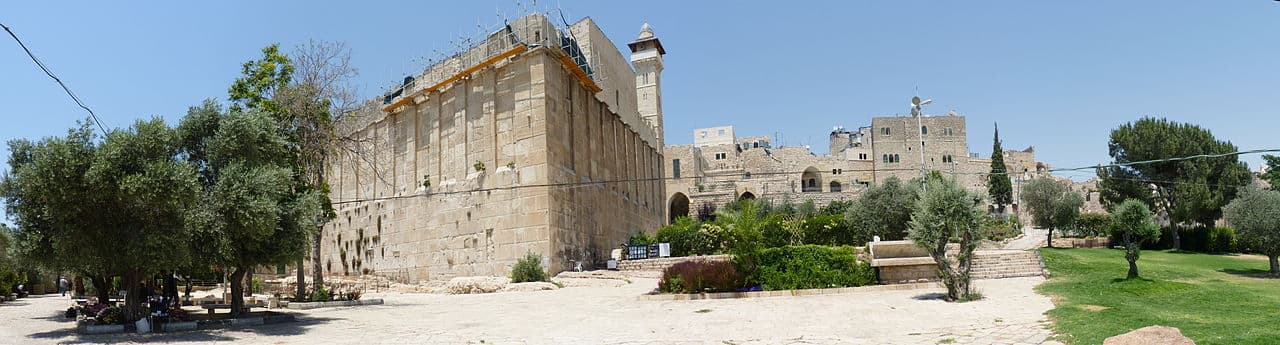
Ricardo Tulio Gandelman, CC BY 2.0, via Wikimedia Commons
Cave of the Patriarchs
Me'arat HaMachpelah (מערת המכפלה) in Hebrew, Al-Haram al-Ibrahimi (الحرم الإبراهيمي) in Arabic
Also known as: Ibrahimi Mosque, Tomb of the Patriarchs, Cave of Machpelah, Abraham's Tomb
Religions: Judaism, Islam | Place Type: Religious complex | Region: Middle East | UNESCO World Heritage Site
Overview
The Cave of the Patriarchs is a series of caves and the building above them in the city of Hebron in the West Bank, State of Palestine. It is the second holiest site in Judaism and an important site in Islam, believed to be the burial place of Abraham, Isaac, Jacob, and their wives Sarah, Rebecca, and Leah.
Present
Following the 1994 Hebron Agreement, reached in the context of the Oslo Accords, the site was divided into separate areas for Jewish and Muslim worship. This arrangement was introduced after a deadly attack in 1994, in which an Israeli settler killed 29 Muslim worshippers, profoundly affecting access and security arrangements at the site.
On ten days each year, corresponding to specific religious holidays, each faith is granted exclusive access to the entire complex.
Both Jewish and Muslim services occur daily in their respective sections.
Religious Significance
Judaism
This is the second holiest site in Judaism after the Temple Mount. According to the Book of Genesis, Abraham purchased the Cave of Machpelah from Ephron the Hittite to bury his wife Sarah (Genesis 23). This was the first purchase of land in Canaan by the Israelites.
The cave is traditionally believed to house the tombs of the Patriarchs—Abraham, Isaac, and Jacob—and the Matriarchs—Sarah, Rebecca, and Leah—who are revered as the spiritual and ancestral forebears of the Jewish people. Rachel, Jacob’s other wife, is buried separately near Bethlehem.
Islam
Muslims refer to the site as the Ibrahimi Mosque (Sanctuary of Abraham). In Islamic tradition, Ibrahim (Abraham) is revered as a prophet and as the father of Ismail (Ishmael), regarded as the ancestor of the Arab peoples. The site is considered the fourth holiest place in Islam, after Mecca, Medina, and Jerusalem.
History & Structure
According to the Bible, Abraham purchased the cave approximately 3,700 years ago.
The massive stone structure enclosing the caves was built by King Herod the Great around 31-30 BCE. The Herodian walls, made of enormous stone blocks, still stand today and are among the best-preserved Herodian structures.
After the Muslim conquest in the 7th century, a mosque was built within the Herodian enclosure. During the Crusader period (12th century), the building was converted to a church. After Saladin's reconquest in 1188, it became a mosque again.
The site contains cenotaphs (memorial markers) above ground indicating the traditional locations of the tombs below.
Notable cenotaphs:
Abraham and Sarah (center of building). Isaac and Rebecca (toward the south). Jacob and Leah (toward the north).
Practical Information
- Admission
- Free.
- Dress Code
- Modest dress required. Women should cover hair in Muslim section. Men need head covering in Jewish section (provided at entrance).
- Getting There
- Hebron is approximately 30 km south of Jerusalem. Special permission or organized tours may be required depending on your nationality and current political situation. Israeli citizens must use specific routes.
- Hours
- The site operates on a complex schedule due to the division between Jewish and Muslim sections: - Jewish section: Generally Sunday-Thursday variable hours, Friday until early afternoon, Saturday (Shabbat) morning services - Muslim section: Open for five daily prayers - Hours change on holidays when one group has exclusive access
- Location
- Old City of Hebron, West Bank/Palestinian Territories.
- Security
- Multiple checkpoints to enter the site. Bring passport/ID. Be prepared for thorough security screening. Photography may be restricted in some areas.
- Tips
- - Check current conditions before visiting. - Visit with a knowledgeable guide.