
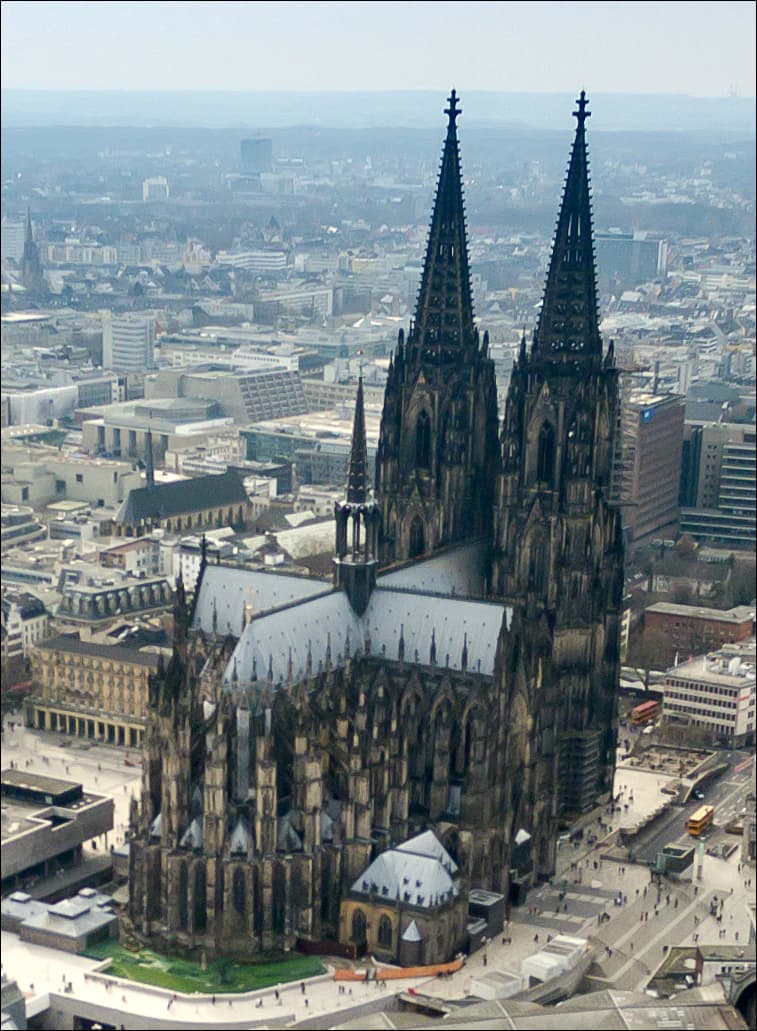
dronepicr, CC BY 2.0, via Wikimedia Commons
Cologne Cathedral
Kölner Dom
Also known as: Cathedral Church of Saint Peter, Hohe Domkirche Sankt Petrus
Religions: Christianity | Place Type: Cathedral | Region: Europe | UNESCO World Heritage Site
Overview
Cologne Cathedral is a Gothic Catholic cathedral in Cologne, Germany, and the seat of the Archbishop of Cologne. At 157 meters tall, it was the world's tallest building when completed in 1880 and remains the tallest twin-spired church globally. This UNESCO World Heritage Site, Germany's most visited landmark attracting 6+ million visitors annually, houses the Shrine of the Three Kings, believed to contain relics of the biblical Magi who visited infant Jesus.
Present
Cologne Cathedral functions as an active Catholic church conducting daily masses, baptisms, weddings, and funerals. As seat of the Archbishop of Cologne, it hosts major ecclesiastical ceremonies. The cathedral chapter (governing body) maintains the building and religious functions. Despite being an active church, the cathedral welcomes 6+ million visitors annually, making it Germany's most popular tourist attraction. Entry to the nave is free, though donations are requested to support ongoing conservation.
The cathedral requires continuous maintenance due to its soft sandstone construction, which erodes from pollution and weather. Scaffolding constantly covers some section of the facade—locals joke the cathedral is perpetually "under construction" just as during medieval times.
The Cathedral Workshop (Dombauhütte) employs stonemasons, sculptors, and restorers using traditional methods to replace damaged stonework. The South Tower is open for climbing, requiring 533 steps on a narrow spiral staircase (no elevator) to reach viewing platforms at 97 meters height with panoramic views over Cologne and the Rhine River. The bells in the towers include St. Peter's Bell (Petersglocke), cast in 1923 as the world's largest free-swinging bell, weighing 24 metric tons. Its deep tone can be heard throughout Cologne.
The Cathedral Treasury Museum displays medieval religious artworks, vestments, and historical artifacts in a modern underground exhibition space. The cathedral hosts classical concerts featuring the massive pipe organ (one of the largest in the world) and choir performances. Cologne Cathedral stands beside the Rhine River and Cologne's central train station (Hauptbahnhof), making it immediately visible to arriving travelers—often their first sight of Cologne.
Religious Significance
Roman Catholicism
Cologne Cathedral's greatest religious treasure is the Shrine of the Three Kings (Dreikönigsschrein), a large gilded sarcophagus believed to contain relics of the Three Wise Men (Magi) who followed the star to Bethlehem to worship the newborn Jesus, as recounted in the Gospel of Matthew. According to tradition, Helena, mother of Emperor Constantine, discovered these relics in Persia during the 4th century and brought them to Constantinople. From there, the relics reached Milan. In 1164, Holy Roman Emperor Frederick Barbarossa conquered Milan and granted the relics to Archbishop Rainald of Dassel, who brought them to Cologne. The shrine, created 1180-1225 by goldsmith Nicholas of Verdun, is considered the largest reliquary in the Western world and a masterpiece of medieval goldsmithing. Cologne became a major medieval pilgrimage destination due to these relics, with the Three Kings venerated as patron saints of travelers.
Modern pilgrims still visit to pray before the shrine, particularly on Epiphany (January 6), the feast celebrating the Magi's visit to Jesus. The cathedral also contains numerous other relics and religious artworks including the 10th-century Gero Cross, the oldest large-scale crucifix north of the Alps. The cathedral hosts daily masses and serves as the seat of the Archbishop of Cologne, one of Germany's most important Catholic positions.
The cathedral's 104-meter-high interior creates an atmosphere of vertical transcendence meant to lift worshippers' thoughts toward heaven—a key Gothic architectural principle. The cathedral survived World War II remarkably intact despite Cologne suffering 262 air raids that destroyed 90% of the city center. Many attribute this to Allied bomber pilots using the cathedral's spires as a navigation landmark and deliberately avoiding direct hits, though the cathedral sustained 14 bomb hits causing significant damage, fully restored by 1956.>
History & Structure
Cologne's first cathedral was built in the 4th century. When Archbishop Rainald brought the Three Kings relics to Cologne in 1164, the city needed a grander cathedral worthy of such treasures. Construction of the current Gothic cathedral began August 15, 1248, following the architectural style of French cathedrals like Amiens. The plan called for a massive five-aisled structure with twin towers on the western facade. Medieval construction continued for 300 years but stalled around 1560 with the cathedral incomplete, lacking the facade towers and much of the nave. A massive crane remained atop the incomplete south tower for 400 years, becoming a Cologne landmark. The cathedral stood unfinished through the Reformation, Thirty Years' War, and Napoleonic period. German Romantic nationalism in the 19th century sparked renewed interest in completing this symbol of German cultural achievement.
The original medieval plans were discovered in 1814 in Paris and later in Cologne, allowing architects to resume construction following the 13th-century design. Work recommenced in 1842 funded by Prussian state and Catholic Church. Using medieval plans combined with 19th-century industrial construction techniques (including steam-powered cranes and iron framework), builders completed the cathedral in 1880, 632 years after construction began. Upon completion, the 157-meter spires made Cologne Cathedral the world's tallest building (surpassing Rouen Cathedral), holding this title until the Washington Monument was finished in 1884. UNESCO designated Cologne Cathedral a World Heritage Site in 1996, recognizing it as "an exceptional work of human creative genius." However, UNESCO placed it on the List of World Heritage in Danger from 2004-2006 due to concerns that high-rise construction nearby would compromise views of the cathedral, removing it from the danger list after the city amended building regulations.
Practical Information
- Accessibility
- Cathedral ground level wheelchair accessible via ramps. Tower accessible via stairs only. Treasury has elevator.
- Admission
- Cathedral entry FREE. Donations requested (suggested €6). Tower climb: €8 adults, €4 children 6-17, family ticket €20 (2 adults + up to 3 children). Treasury: €8 adults, €4 reduced. Combo tower + treasury: €12 adults.
- Best times in the day
- Early morning or late afternoon for fewer crowds. Weekdays quieter than weekends. Climb tower early to avoid long queues.
- Climbing
- South Tower open 09:00-18:00 (March-October), 09:00-16:00 (November-February). Last admission 30 minutes before closing. 533 steps, no elevator. Not suitable for mobility-impaired visitors. Takes 20-40 minutes.
- Dress Code
- Respectful clothing requested. As active church, modest attire appropriate.
- Duration
- Allow 30-60 minutes for cathedral visit, 30-45 minutes for tower climb, 30 minutes for treasury.
- Getting There
- Cologne Hbf (main station) is adjacent to cathedral (1-minute walk). Trains from throughout Germany and Europe. From Frankfurt Airport: 1 hour by ICE train. From Düsseldorf Airport: 15 minutes by train. Cologne-Bonn Airport: 15 minutes by S-Bahn train. Tram/U-Bahn: Dom/Hbf station.
- Guided Tours
- Available in German and English. Check cathedral website for times and booking. Audio guides available.
- Hours
- Cathedral open daily 06:00-20:00 (November-April), 06:00-21:00 (May-October). May close temporarily during services or events. Check website for current hours.
- Location
- Cologne Cathedral is in Cologne city center next to the Hauptbahnhof (main train station), Nordrhein-Westfalen, Germany. Address: Domkloster 4, 50667 Köln.
- Photography
- Permitted for personal use. No flash. Commercial photography requires permission.