
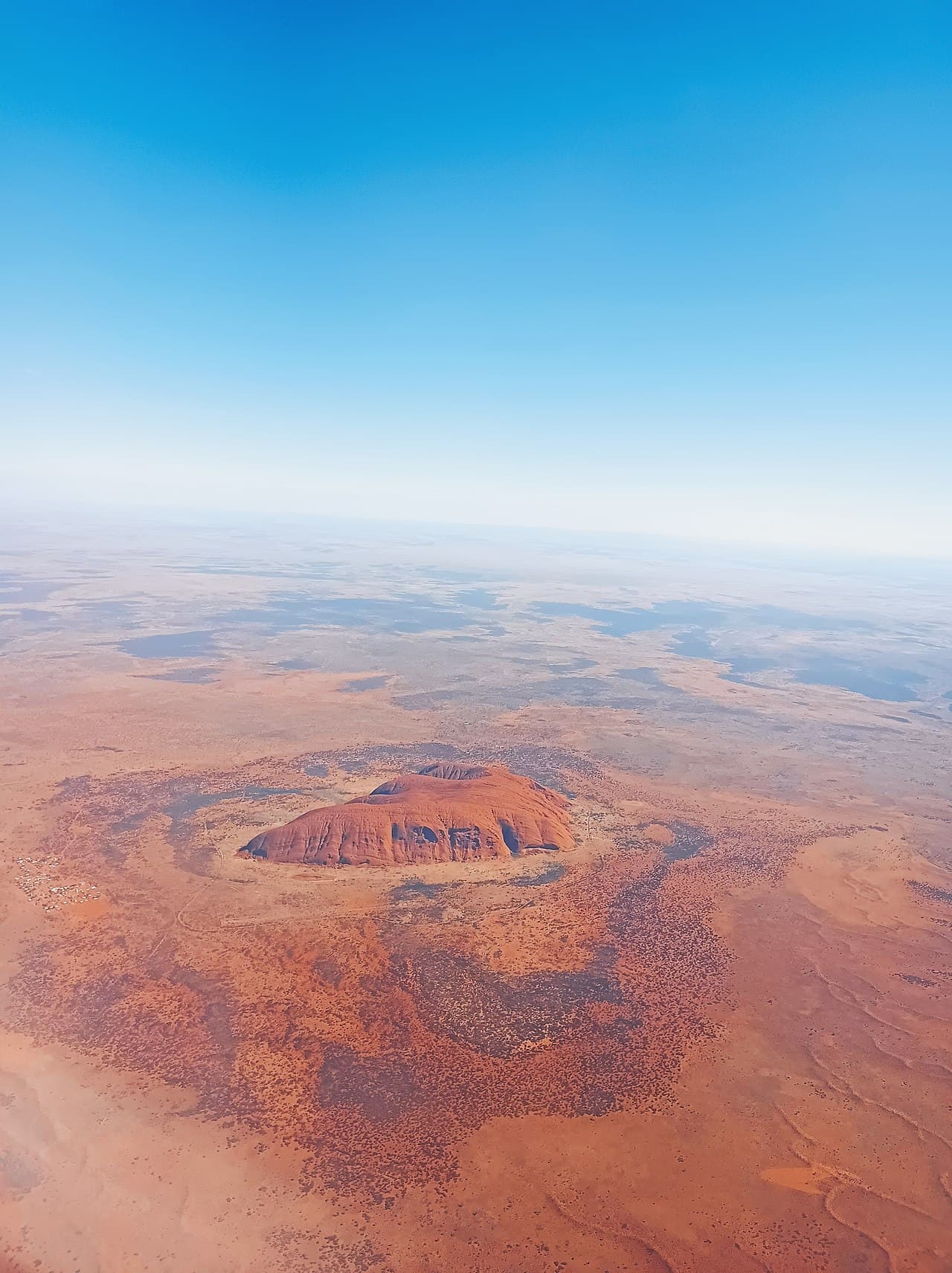
Chatura Rathnayake, CC BY-SA 4.0, via Wikimedia Commons
Uluru
Uluṟu
Also known as: Ayers Rock
Religions: Indigenous | Place Type: Mountain | Region: Oceania | UNESCO World Heritage Site
Overview
Uluru is a massive sandstone monolith rising 348 meters above the surrounding plain in the heart of Australia's Red Centre, located in the Uluṟu-Kata Tjuṯa National Park in the Northern Territory, approximately 450 kilometers southwest of Alice Springs. It is sacred to the Anangu people, the traditional Aboriginal owners who have inhabited this land for over 30,000 years. Uluru is one of Australia's most iconic natural landmarks and a deeply spiritual site where ancient creation stories are written in the rock's caves, waterholes, and formations. The park was dual-listed as a UNESCO World Heritage Site in 1987 for its natural values and again in 1994 for its cultural landscape.
Present
Uluru-Kata Tjuta National Park is jointly managed by the Anangu traditional owners and Parks Australia under a co-management agreement established when the land was returned to the Anangu in 1985 under the condition of leasing it back to the Australian government for the next 99 years.
The park is open year-round with seasonal hours. The fee supports park management, conservation, and cultural programs.
The Uluru-Kata Tjuta Cultural Centre, located near the base of Uluru, serves as the visitor orientation point. The center features exhibits about Anangu culture, Tjukurpa stories, traditional practices, and the park's natural environment, with displays in multiple languages. Anangu rangers and guides work at the center, sharing selected cultural knowledge and answering questions. The center also houses galleries selling authentic Anangu art, crafts, and books, providing economic opportunities for the community.
Visitors can take several walking tracks and shorter walks to specific waterholes and cultural sites. Climbing Uluru is permanently banned as of October 2019 to respect the Anangu's cultural beliefs and protect the sacred site. The park employs traditional fire management practices, with Anangu rangers conducting controlled burns to maintain the landscape, reduce wildfire risk, and encourage plant and animal diversity as practiced for thousands of years.
Cultural tours led by Anangu guides offer deeper insights into Tjukurpa stories, bush foods, traditional practices, and the Anangu's relationship with the land. Annual events include Tjungu Festival, celebrating Anangu culture with art, music, dance, and workshops.
Religious Significance
Indigenous Australian (Anangu)
Uluru holds profound spiritual significance for the Anangu people as a living cultural landscape embodying Tjukurpa (pronounced chook-orr-pa), the foundation of Anangu culture encompassing creation stories, ancestral law, ceremony, and the relationship between people, plants, animals, and land. Tjukurpa is not merely mythology but living law that governs all aspects of life and connects the Anangu to their ancestors and country. According to Anangu beliefs, the natural landmark was formed by ancestral beings during the Dreaming (the creation period when ancestral spirits shaped the land). The Anangu Dreaming stories tell how 10 ancestral beings created Uluru's features—its caves, waterholes, rock formations, and fissures—through their actions and battles during creation time.
One of the most important stories is that of Kuniya (the woma python woman) and Liru (the venomous snake man). Kuniya traveled from the east carrying her eggs strung around her neck to Uluru's northeast corner at Kuniya Piti, where she left them to hatch. When Liru attacked Kuniya's nephew, a fierce battle ensued at Muṯitjulu Waterhole on Uluru's south side. Kuniya struck Liru with her digging stick, and the marks of her blows are still visible on the rock's eastern face as grooves and indentations. This story teaches important lessons about kinship obligations, proper behavior, and the consequences of violence. Other ancestral beings associated with Uluru include Mala (hare wallabies), whose people lived on Uluru's north face and are central to Anangu ceremony, and Lungkata (blue-tongued lizard), whose story teaches about greed and sharing.
Over 40 sacred Aboriginal sites surround Uluru, and 11 Tjukurpa trails connect locations associated with specific creation stories. These sites include caves used for sacred ceremonies, initiation rituals, and teaching. Many caves contain rock paintings depicting Tjukurpa stories, though most sacred sites are restricted from public access to preserve their sanctity.
The Anangu maintain that Uluru is not just a rock but a living ancestor, and they have cultural obligations to care for it through traditional practices like controlled burning, protecting sacred sites, and performing ceremonies. Walking on Uluru was traditionally restricted to initiated men for ceremonial purposes, and the Anangu campaigned for decades to end tourist climbing, which they considered disrespectful to their ancestors and culture. In October 2019, climbing Uluru was permanently banned, fulfilling a long-held wish of the traditional owners.
Today, Anangu guides share selected (non-sacred) Tjukurpa stories with visitors, offering insight into one of the world's oldest continuous cultures while protecting the sacred knowledge that must remain within the community.
History & Structure
Uluru is an inselberg (isolated hill) composed of arkose sandstone, formed approximately 550 million years ago when sediments from eroding mountains were deposited in an inland sea. Over millions of years, tectonic forces tilted these sediments nearly vertically, and erosion exposed the massive rock formation we see today. The visible portion of Uluru rises 348 meters (1,142 feet) above the desert floor, but the rock extends several kilometers beneath the surface, making it comparable to an iceberg. Uluru measures 3.6 kilometers long and 1.9 kilometers wide, with a circumference of 9.4 kilometers at its base. Its distinctive red-orange color comes from iron oxide (rust) in the sandstone.
The surface features numerous caves, waterholes, and rock formations created by weathering and, according to Anangu belief, by ancestral beings during the Dreaming. Archaeological evidence shows the Anangu and their ancestors have inhabited the Uluru region for at least 30,000 years, maintaining an unbroken cultural connection to the land. For millennia, the area around Uluru provided water from permanent waterholes fed by runoff from the rock's surface, shelter in caves, and resources for hunting and gathering. The Anangu developed intricate knowledge of the land's plants, animals, seasons, and water sources, all encoded in Tjukurpa stories and songlines (iwara) that map the landscape through song, story, and ceremony.
European contact came in 1873 when explorer William Gosse became the first European to document Uluru, naming it Ayers Rock after Sir Henry Ayers, the Chief Secretary of South Australia. Throughout the early 20th century, European-Australian presence increased with pastoral leases, mining interests, and eventually tourism.
The area became a national park in 1958, but control remained with the Australian government, and the Anangu had no formal say in management despite it being their ancestral land. Tourism grew rapidly from the 1950s-1970s, and climbing Uluru became a popular activity, despite Anangu requests to respect the rock's sacred nature. By the 1970s, the Anangu began campaigns for land rights and recognition of their cultural connection to Uluru. 1985 the Australian government returned ownership of Uluru-Kata Tjuta National Park to the Anangu people in a historic land rights agreement, but under the condition that the Anangu immediately lease the park back to the Australian government for 99 years.
In 1993, the park was officially renamed Uluru/Ayers Rock, with the Aboriginal name taking precedence. After decades of campaigning by the Anangu, climbing Uluru was permanently banned on October 26, 2019.
Practical Information
- Accessibility
- Paved sections of Mala Walk wheelchair accessible. Cultural Centre fully accessible. Base Walk unpaved, uneven terrain, not wheelchair accessible. Wheelchairs available for loan at Cultural Centre.
- Accommodation
- Yulara (Ayers Rock Resort) has options from campground to luxury hotels (AUD $50-800+ per night), Alice Springs has more budget options.
- Admission
- AUD $38 for 3-day adult pass, AUD $50 for annual pass. Free for children under 18. Purchase online or at entry station. Park pass required for entry to park. The fee supports park management, conservation, and cultural programs.
- Best Times of the year (Best Time to Visit)
- April-September (winter/dry season): mild temperatures 20-28°C (68-82°F) days, 5-15°C (41-59°F) nights. Clear skies, comfortable walking. October-March (summer/wet season): hot 35-45°C (95-113°F) days, afternoon thunderstorms possible. Walks may close during extreme heat. Peak season: June-August (winter)—busy, book accommodation early.
- Booking
- Book early especially in peak season.
- Climate (Weather)
- Desert climate, hot summers, mild winters. Temperature extremes: summer 45°C (113°F), winter nights near freezing. Sun intense—bring sun protection. Rain minimal but intense storms possible October-March.
- Climbing
- Climbing Uluru permanently banned since October 26, 2019, to respect Anangu culture and protect sacred sites. Violators face fines.
- Contact
- Uluru-Kata Tjuta National Park, Parks Australia. Phone: +61 8 8956 1128. Website: uluru.gov.au.
- Dress Code (Clothing)
- Wear light, breathable fabrics covering arms and legs for sun protection. Layers for cool winter mornings/evenings. Respectful clothing at Cultural Centre and sacred sites.
- Duration
- Minimum half-day, recommended full day.
- Etiquette
- Uluru is sacred to the Anangu. Approach with respect. Learn about Tjukurpa at Cultural Centre before exploring. Support Anangu community by purchasing art and crafts from Cultural Centre galleries.
- Etiquette (Cultural Sensitivity)
- Follow all signage. Approach the place with respect. Do not enter restricted areas. Do not photograph sacred sites where prohibited. Do not touch rock art or remove rocks/plants. Do not climb fences or barriers. Dispose of waste properly. Listen to ranger guidance.
- Getting There
- By air: Ayers Rock Airport (Connellan Airport) is 15 km from Yulara, with direct flights from Sydney, Melbourne, Brisbane, and Cairns (flight time 2-3.5 hours). By car: Drive from Alice Springs (450 km, 4.5 hours) via Stuart and Lasseter Highways—rental cars available in Alice Springs. Tours: Organized tours from Alice Springs include transportation, guide, park entry, and meals (1-3 day packages, AUD $200-800).
- Guided Tours
- Anangu-guided cultural tours available (AUD $130-200, 2-4 hours), covering bush foods, Tjukurpa stories, traditional tools, and Anangu perspectives. Sunrise and sunset tours offered by various operators. Self-guided audio tours available.
- Hours (Park Hours)
- Open daily year-round. Hours vary seasonally: summer 5:00 AM-9:00 PM, winter 6:30 AM-7:30 PM. Check Parks Australia website for exact monthly hours.
- Key Sites
- Uluru Base Walk (10.6 km circuit, 3-4 hours, moderate difficulty), Mala Walk (2 km return, ranger-guided tours available), Mutitjulu Waterhole and Kuniya Walk (1 km return, leads to waterhole and Kuniya Dreaming site), Cultural Centre (exhibits, Anangu art galleries, ranger talks), sunrise and sunset viewing areas (Talinguru Nyakunytjaku sunrise platform recommended).
- Location
- Uluru is located in Uluru-Kata Tjuta National Park in Australia's Northern Territory, approximately 450 km southwest of Alice Springs. The nearest town is Yulara (also called Ayers Rock Resort), 20 km from Uluru, offering accommodation, restaurants, and services.
- Nearby Sites
- Kata Tjuta (The Olgas), 50 km west, also sacred to Anangu with walking tracks (Valley of the Winds Walk 7.4 km, Walpa Gorge Walk 2.6 km). Combined tours of Uluru and Kata Tjuta available.
- Permits
- Drones prohibited without permit.
- Photography
- Permitted in most areas for personal use. Certain sacred sites marked with "No Photography" signs—respect these restrictions.
- Restrictions (Climbing)
- Climbing Uluru permanently banned since October 26, 2019, to respect Anangu culture and protect sacred sites. Violators face fines.
- Security (Safety)
- Extreme heat can cause dehydration and heat stroke. Drink water regularly, rest in shade, avoid midday walks in summer. Watch for snakes (stay on paths). Flies persistent November-March (bring head net if sensitive). Emergency services available via park rangers and Yulara.
- What to Bring
- Water (minimum 2 liters per person for base walk, refill at Cultural Centre), sun protection (SPF 50+ sunscreen, hat, sunglasses, long sleeves), sturdy walking shoes, insect repellent (flies common especially November-March), camera, cash and cards (for Cultural Centre purchases).