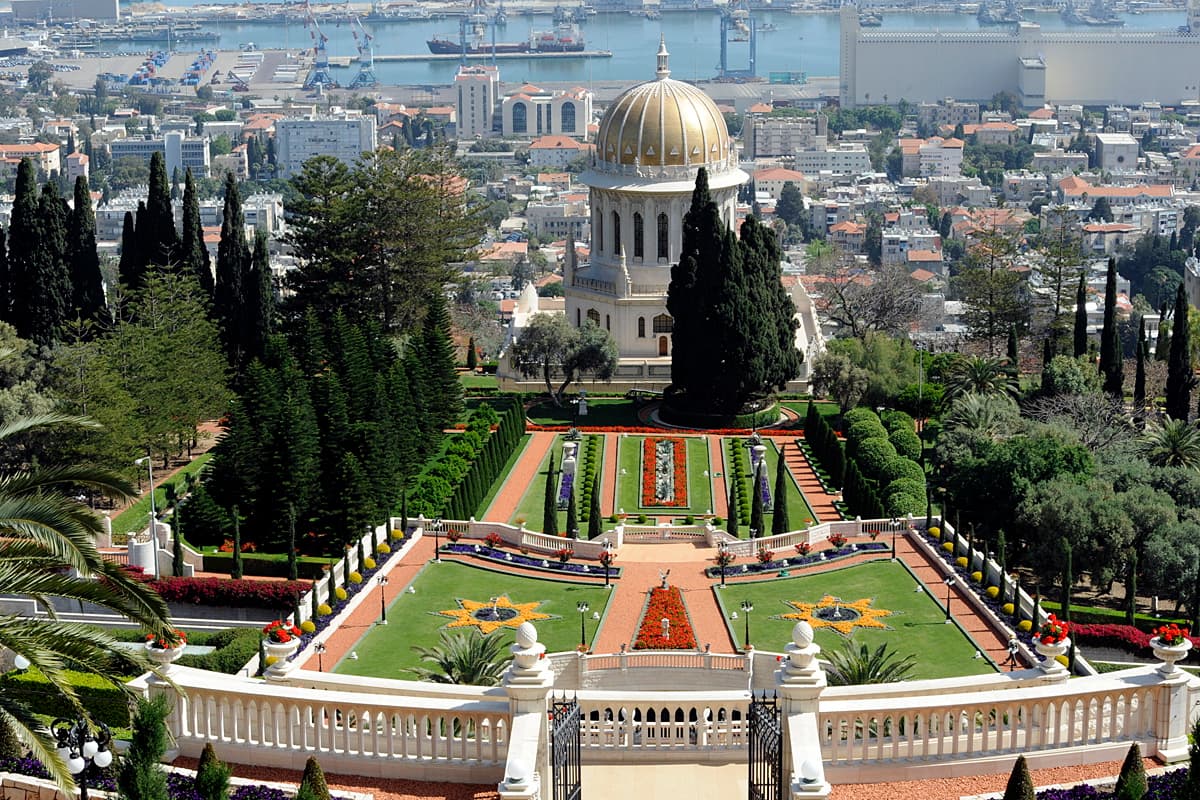
U.S. Embassy Tel Aviv, CC BY-SA 2.0, via Wikimedia Commons
Bahá'í World Centre
Markaz-i Jaháníy-i Bahá'í
Also known as: Bahá'í Holy Places in Haifa and the Western Galilee
Religions: Bahá'í Faith | Place Type: Religious complex | Region: Middle East | UNESCO World Heritage Site
Overview
The Baháʼí World Centre, located in the cities of Haifa and Acre (Akko) in northern Israel, is the spiritual and administrative heart of the Baháʼí Faith. It consists of a series of shrines, gardens, and administrative buildings that serve as the global focal point for the worldwide Bahá'í community.
Present
The Bahá'í World Centre serves as both pilgrimage destination and administrative headquarters for the worldwide Bahá'í community of approximately 5-8 million members.
The Universal House of Justice, the nine-member governing council of the Bahá'í Faith, is located in the distinctive neoclassical building on Mount Carmel, elected every five years by representatives from around the world.
Bahá'í pilgrimage is open to all Bahá'ís, typically arranged in nine-day visits. The terraced gardens, however, are open to all visitors regardless of faith.
The gardens are maintained by international volunteers who come for periods of service. The meticulous care of the gardens reflects Bahá'í principles of beauty, order, and service.
Religious Significance
Bahá'í Faith
The Bahá'í Faith is a monotheistic religion founded in 19th-century Persia (Iran). Its central teaching is the unity of all people and religions. Bahá'ís believe in one God who has sent messengers throughout history, including Abraham, Moses, Jesus, Muhammad, and most recently, Bahá'u'lláh (1817-1892), whom Bahá'ís consider the messenger for this age.
Bahá'u'lláh was exiled by the Ottoman Empire to the prison city of Acre, Israel, in 1868. He spent his final years in this area, and died in 1892 at the Mansion of Bahjí near Acre.
History & Structure
The Shrine of Bahá'u'lláh: Located near Acre, this is the holiest site for Bahá'ís - the point toward which they turn during daily prayers (the Qiblih). The shrine is topped by a golden dome and surrounded by 19 terraces of meticulously maintained gardens stretching from the foot to the crest of Mount Carmel, over one kilometer in length.
The Shrine of the Báb: The Báb (meaning "the Gate") was born as Siyyid 'Alí-Muhammad in 1819 in Shiraz, Persia. He declared in 1844 that he was preparing humanity for the coming of a greater messenger - Bahá'u'lláh. The Báb was executed in 1850 for his teachings and his remains were eventually brought to this shrine on Mount Carmel.
Other Sites:
The Mansion of Bahjí - where Bahá'u'lláh spent his final years. The House of 'Abdu'l-Bahá in Haifa. The Prison of Acre. The Universal House of Justice - the governing body of the Bahá'í Faith, located on Mount Carmel.
The sites were inscribed as a UNESCO World Heritage Site in 2008.
Practical Information
- Getting There
- - Haifa: Gardens are on Mount Carmel, accessible by bus or taxi. The Carmelit subway stops nearby. - Acre: Bus or train from Haifa (about 30 minutes)
- Location
- The main sites are in Haifa and Acre (Akko) in northern Israel.
- Shrine of Bahá'u'lláh (Acre area)
- - **Hours:** 9 AM - 12 PM daily - **Admission:** Free - **How to reach:** About 30 minutes north of Haifa by car or bus
- Shrine of the Báb
- - **Hours:** 9 AM - 12 PM daily - **Admission:** Free - **Dress Code:** Modest dress required. Remove shoes before entering.
- The Terraced Gardens (Haifa)
- - **Hours:** Daily 9 AM - 5 PM. Closed Bahá'í holy days and Yom Kippur. - **Admission:** Free - **Tours:** Free guided tours available in multiple languages; check website for schedule - **Access:** Enter from any of several terrace levels. The panoramic view is from the upper terrace (Yefe Nof Street)
- Tips
- - The gardens are internationally recognized for their horticultural design and for incorporating sustainable landscaping practices.