
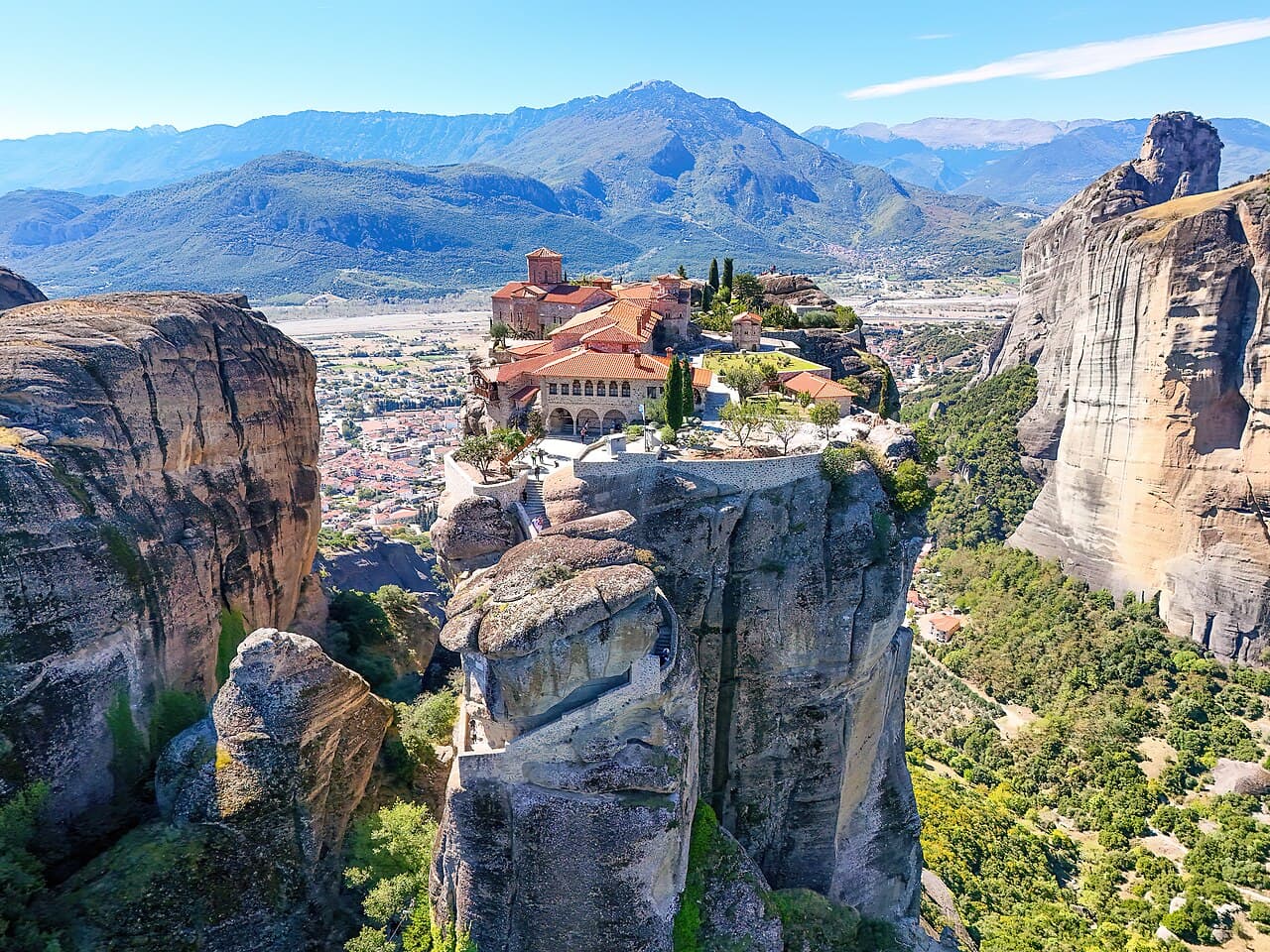
Giles Laurent, CC BY-SA 4.0, via Wikimedia Commons
Monasteries of Meteora
Μετέωρα
Also known as: Meteora, Suspended in Air
Religions: Eastern Orthodox | Place Type: Monastery | Region: Europe | UNESCO World Heritage Site
Overview
The Monasteries of Meteora are a group of Eastern Orthodox monasteries in central Greece, built on natural rock pillars rising above the Thessalian plain. Founded between the 14th and 16th centuries, the monastic community developed as a place of seclusion and prayer, with monasteries established on elevated rock formations that were difficult to access. Today, six monasteries remain active. Meteora ("suspended in mid-air" in Greek) is recognized as a UNESCO World Heritage Site for its religious, historical, and cultural significance.
Present
Today, the six monasteries remain active, with resident monks and nuns conducting daily services. The monasteries attract approximately 1.5-2 million visitors annually, creating tension between tourism and monastic life. Visiting hours, dress requirements, and photography restrictions are enforced to protect the religious atmosphere. Conservation is overseen by the Greek Ministry of Culture, with erosion and climate-related impacts requiring continuous monitoring.
Entrance fees support maintenance and the monastic communities, which are significantly smaller than in the past, sometimes consisting of only a few residents. Major feast days continue to attract Orthodox faithful. Kalambaka and the nearby village of Kastraki serve as access points, providing accommodation and services. Hiking paths connect the monasteries, and climbing is permitted on non-monastic rock faces under regulation. The surrounding area is protected parkland, preserving the landscape and local biodiversity.
Religious Significance
Eastern Orthodox Christianity
Meteora developed as a center of Eastern Orthodox monasticism for monks seeking isolation, ascetic discipline, and continual prayer. The elevated rock pillars provided both physical seclusion and protection during periods of instability, allowing monastic life to continue through the Byzantine and Ottoman eras. At its height in the 16th century, 24 monasteries were active; today six remain functioning communities: Great Meteoron, Varlaam, Rousanou (a nunnery), Holy Trinity, St. Nicholas Anapafsas, and St. Stephen (a nunnery).
The monasteries follow the cenobitic rule, with communal life structured around shared prayer, work, and study under an abbot or abbess. Daily life centers on the cycle of Orthodox services and the continuation of the hesychast tradition of inner prayer. Holy relics of saints are preserved in ornate reliquaries. Pilgrims visit to venerate these relics, attend liturgies, receive blessings, and seek spiritual renewal.
The monasteries preserve important collections of icons, manuscripts, vestments, and liturgical objects, and their katholika contain 16th-century frescoes of the Cretan School, including works by Theophanes the Cretan. The monasteries welcome visitors as a form of Orthodox hospitality (philoxenia) while maintaining their primary function as active communities of prayer.
History & Structure
Hermits settled in caves at the base of the Meteora rocks between the 9th and 11th centuries. Organized monastic communities emerged in the 14th century, when monks began constructing monasteries on the rock summits for security. The first was Great Meteoron, founded around 1340 by St. Athanasios the Meteorite, with later expansion by his successor St. Ioasaph. During the 15th and 16th centuries, Orthodox rulers and noble families, including Serbian patrons, financed further construction, decoration, and libraries. Each monastery was organized around a central katholikon, with refectories, cells, storerooms, and defensive walls adapted to the rock formations.
Access to the monasteries required extraordinary effort. Originally, monks climbed removable wooden ladders or were hauled up in nets suspended from winches. Supplies arrived the same way. This system continued into the 20th century, and visitors experienced ascent in swaying baskets. Carved stairways introduced in the 1920s made access permanent.
Meteora was inscribed as a UNESCO World Heritage Site in 1988.
Practical Information
- Accessibility
- Stone steps (100-300 steps) cut into rocks lead to each monastery. Fairly strenuous climbing required. Not accessible with wheelchair due to steps and steep terrain.
- Accommodation
- Kalambaka has hotels (€40-80), guesthouses (€25-50), hostels (€15-25). Kastraki smaller, quieter, closer to rocks. Book ahead in peak season.
- Accommodation
- Kalambaka has hotels (€40-80), guesthouses (€25-50), hostels (€15-25). Kastraki smaller, quieter, closer to rocks. Book ahead in peak season.
- Admission
- €3-5 per monastery. Cash only at most. Tickets purchased at each monastery entrance. No multi-monastery pass.
- Best Times of the year
- April-May or September-October for pleasant weather and moderate crowds. Summer (June-August) very crowded and hot. Winter (November-March) quiet but shorter hours, possible snow/ice on steps.
- Dress Code
- STRICTLY ENFORCED. Women: long skirts below knee (no pants), covered shoulders. Skirts available for rent/borrowing at entrances if needed. Men: long pants (no shorts), covered shoulders. Modest dress required; revealing clothing refused at entry.
- Duration
- Allow 4-6 hours for visiting 3-4 monasteries including travel between them. Full day for all six.
- Etiquette
- Active monasteries with resident monks and nuns, maintain quiet, modest behavior. Attend liturgies if interested (usually early morning), but arrive on time and participate respectfully.
- Getting Around
- The six monasteries are spread across several kilometers of road winding through the rock formations. Walking is possible (strenuous, full day required for all six, steep inclines). Most visitors rent cars in Kalambaka (€30-50/day), hire taxis (€40-60 for 3-4 monastery tour), or join organized tours (€20-40). Local buses run limited routes (check schedules in Kalambaka).
- Getting There
- By train: Athens to Kalambaka (4.5-5.5 hours, €15-30); Thessaloniki to Kalambaka (3 hours, €10-20). The train journey through mountains is scenic. By bus: KTEL buses from Athens (5 hours, €25-35) and Thessaloniki (3 hours, €15-25). By car: From Athens, take E75/A1 north through Lamia (4.5 hours). Parking available at monastery entrances.
- Hours
- **Monastery Hours (2025):** Each monastery has different hours and closure days. **Great Meteoron:** Daily except Tuesday 09:00-17:00 (Nov-Mar), 09:00-18:00 (Apr-Oct). **Varlaam:** Daily except Friday 09:00-16:00 (Nov-Mar), 09:00-18:00 (Apr-Oct). **Rousanou:** Daily 09:00-17:00 year-round. **Holy Trinity:** Daily except Wednesday 09:00-17:00 (winter), 09:00-18:00 (summer). **St. Stephen:** Daily except Monday 09:30-17:30 (winter), 09:30-18:30 (summer). **St. Nicholas Anapafsas:** Daily except Friday 09:00-15:30 year-round. Verify current hours locally as they change seasonally.
- Language
- Greek. Some English in tourist areas.
- Location
- Meteora is near Kalambaka and Kastraki villages in Thessaly, central Greece, 350 km northwest of Athens, 230 km southwest of Thessaloniki.
- Photography
- Generally permitted in courtyards and exteriors. PROHIBITED inside churches to protect frescoes. Respect signs and restrictions.
- Preparation
- Bring water, sun protection, good shoes.
- Route Options
- Visiting all six requires full day and significant climbing. Most visitors see 2-4 monasteries. Recommended: Great Meteoron (largest, most comprehensive), Varlaam (excellent frescoes, museum), and one of the nunneries (Rousanou or St. Stephen).