
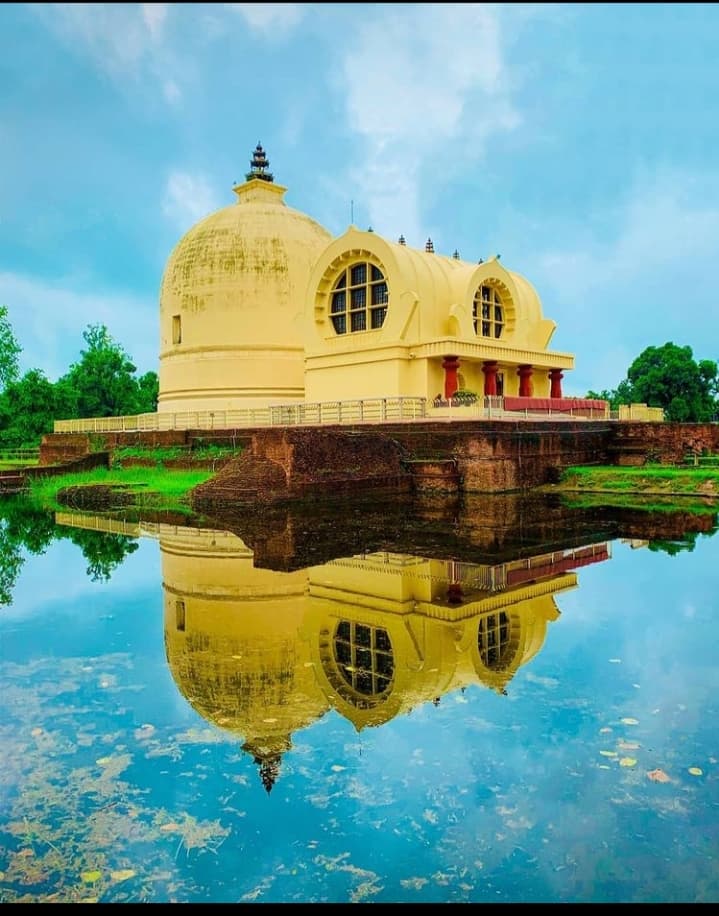
Am9612, CC BY-SA 4.0, via Wikimedia Commons
Kushinagar
Kuśinagara / कुशीनगर
Also known as: Kusinara, Kasia
Religions: Buddhism | Place Type: Pilgrimage site | Region: Asia
Overview
Kushinagar is one of the holiest Buddhist pilgrimage sites, as it is the place where Gautama Buddha passed away and attained Parinirvana (final liberation) at the age of 80, in the 5th century BCE. Located in Uttar Pradesh, India, the site includes the Parinirvana Temple, housing a 6.1-meter reclining Buddha statue depicting his final moments; the Parinirvana Stupa, marking the place of his passing; and the Ramabhar Stupa, traditionally identified as his cremation site. Kushinagar is one of the four most sacred sites in Buddhism.
Present
Kushinagar is managed by the Archaeological Survey of India and the Kushinagar Development Authority. The site attracts hundreds of thousands of pilgrims annually from Buddhist countries worldwide, particularly Thailand, Myanmar, Sri Lanka, Japan, China, and Tibet.
The Parinirvana Temple remains an active place of worship with continuous prayers and meditation. Pilgrims circumambulate the temple and pay respects to the reclining Buddha. The Ramabhar Stupa, located 1.5 km away, marks Buddha's cremation site and is also circumambulated by devotees.
Multiple temples and monasteries have been built by different Buddhist nations, each reflecting their architectural traditions: Indo-Japanese temple, Myanmar temple, Chinese temple, Thai temple, Korean temple, Sri Lankan temple, and Tibetan temple. These provide accommodation and meditation spaces for pilgrims.
The site hosts major celebrations during Buddha Purnima (April-May) and other Buddhist festivals, with thousands of monks and pilgrims gathering for prayers, meditation, and teachings.
Religious Significance
Buddhism
Kushinagar is one of four essential pilgrimage sites identified by Buddha himself before his death. According to the Mahaparinibbana Sutta (Great Discourse on the Final Nirvana), at age 80, after 45 years of teaching, Buddha undertook his final journey with his disciple Ananda.
After consuming a meal at the home of a devotee named Cunda, Buddha fell gravely ill with dysentery but continued walking to Kushinagar. Understanding his end was near, Buddha asked Ananda to prepare a couch between two sal trees. Lying on his right side with his head to the north and face to the west, Buddha delivered his final teachings to his disciples. He then entered Parinirvana, the final passing away with no further rebirth, demonstrating the ultimate goal of Buddhist practice—complete liberation from the cycle of death and rebirth (samsara).
The site represents the culmination of Buddha's earthly existence and his achievement of ultimate liberation. For Buddhists, visiting Kushinagar and contemplating impermanence and the nature of existence is a profound spiritual practice.
History & Structure
Buddha's Parinirvana: Around 483 BCE, Buddha passed away in a grove of sal trees in what was then the small town of Kusinara, capital of the Malla kingdom.
Ancient Stupas: Shortly after Buddha's cremation, the Malla people built the original Parinirvana Stupa to enshrine his relics and the Ramabhar Stupa at his cremation site.
Emperor Ashoka: King Ashoka visited in the 3rd century BCE and built several stupas and monasteries. Chinese pilgrim Xuanzang documented these structures during his visit in the 7th century CE.
Parinirvana Temple and Statue: The current Parinirvana Temple was built by the Indian government in 1956 to commemorate the 2,500th anniversary of Buddha's Parinirvana. Inside lies a massive reclining Buddha statue, 6.1 meters (20 feet) long, carved from red sandstone from Mathura dating to the 5th century CE (Gupta period). The statue was discovered broken and buried in 1876 by British archaeologist A.C.L. Carlleyle and subsequently restored.
Mathakuar Shrine: A 10th-11th century CE seated Buddha statue in the bhumi sparsha mudra (earth-touching gesture) was discovered in 1876 and enshrined in a temple built in 1927.
Rediscovery: The site was rediscovered by Alexander Cunningham in 1861-1862, who conclusively identified the ruins as Buddha's Parinirvana site.
Practical Information
- Accommodation
- Several budget hotels and guesthouses in Kushinagar. Various international monasteries offer basic accommodation for pilgrims, often by donation.
- Admission
- Entry to main temple complex is free. Small fees may apply for museum.
- Best Time to Visit
- October to March for pleasant weather. Buddha Purnima (April-May) sees large gatherings. Avoid summer (April-June) when temperatures exceed 40°C.
- Dress Code
- Modest clothing required. Remove shoes before entering temple areas.
- Getting There
- Nearest airport is Gorakhpur (51 km). Kushinagar has a small railway station with limited connections; Gorakhpur Junction (53 km) is the main railhead. Regular buses from Gorakhpur. Taxis available.
- Hours
- Parinirvana Temple and complex open daily, sunrise to sunset (approximately 5:30 AM to 7:00 PM). Some temples have extended hours.
- Key Sites
- Parinirvana Temple with reclining Buddha, Parinirvana Stupa (immediately behind temple), Ramabhar Stupa (1.5 km away, cremation site), Mathakuar Shrine, multiple international monasteries.
- Location
- Kushinagar is in Kushinagar district, Uttar Pradesh, 53 km east of Gorakhpur on National Highway 27.
- Meditation
- Quiet meditation is encouraged. Early morning and evening are particularly peaceful times.
- Photography
- Generally allowed in courtyards. Respectful photography only inside temples.