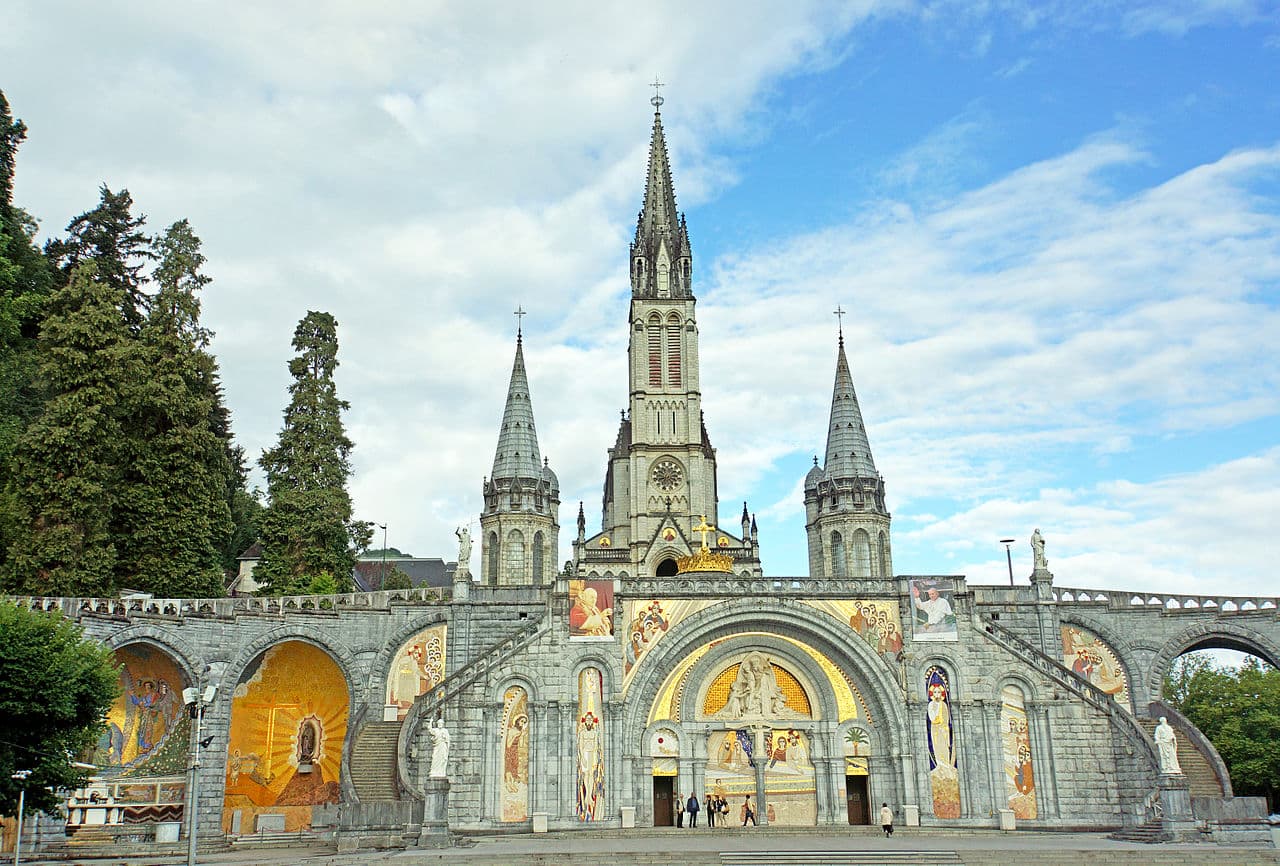
Dennis G. Jarvis, CC BY-SA 2.0, via Wikimedia Commons
Sanctuary of Our Lady of Lourdes
Sanctuaire Notre-Dame de Lourdes
Also known as: Lourdes Sanctuary, Grotto of Massabielle, Shrine of Lourdes
Religions: Christianity | Place Type: Sanctuary | Region: Europe
Overview
The Sanctuary of Our Lady of Lourdes is a Catholic pilgrimage site in Lourdes, France, centered on the Grotto of Massabielle where the Virgin Mary allegedly appeared 18 times to 14-year-old Bernadette Soubirous in 1858. Located in the Pyrenees mountains of southwestern France, Lourdes has become one of the world's most visited Catholic pilgrimage destinations, welcoming 6-8 million pilgrims and visitors annually who seek spiritual renewal and healing at the sacred spring discovered during the apparitions.
Present
The Sanctuary of Our Lady of Lourdes operates as an active pilgrimage destination and place of Catholic worship, administered by the Diocese of Tarbes and Lourdes. The site welcomes 6-8 million visitors annually from over 140 countries, making Lourdes France's second-most-visited tourist destination after Paris. Approximately 400,000-500,000 sick or disabled pilgrims visit annually, many traveling in organized pilgrimage groups that provide medical support.
The sanctuary is open daily free of charge, accessible 24 hours. Major pilgrimage season runs April-October, with Assumption (August 15) drawing the largest crowds. Daily programs include masses in multiple languages, Blessed Sacrament processions (afternoons), and evening torchlight Marian processions where thousands of pilgrims carry candles while singing hymns and reciting prayers in various languages. The baths (piscines), where pilgrims immerse themselves in spring water, operate free of charge daily (9:00-11:00 and 14:00-16:00). Volunteers assist pilgrims disrobing, entering the cold water-filled pools, and praying. Waiting times vary (15 minutes to 2+ hours depending on crowds).
Fountains provide spring water for drinking and filling containers. The Lourdes water is tested regularly and meets drinking water standards. Medically, it is ordinary spring water with no special chemical properties; attributed healings are considered faith-based miracles, not chemically caused. The sanctuary employs hundreds of staff and relies on 10,000+ volunteers (hospitaliers) who assist sick pilgrims, push wheelchairs, serve meals, and help with ceremonies. Many volunteers return annually for decades.
Religious Significance
Roman Catholicism
Lourdes' religious significance centers on Marian apparitions (visions of the Virgin Mary) witnessed by Bernadette Soubirous between February 11 and July 16, 1858. Bernadette, a poor, illiterate 14-year-old miller's daughter suffering from asthma, reported seeing "a Lady" in a grotto while collecting firewood with her sister and friend. The Lady appeared 18 times over five months. Bernadette described the Lady as young, beautiful, dressed in white with a blue sash, with a golden rose on each foot and a rosary. On March 25, the Lady revealed her identity in the local Gascon dialect: "I am the Immaculate Conception"—referencing the Catholic doctrine (declared dogma in 1854, four years earlier) that Mary was conceived 'without original sin.' This theological statement from an illiterate girl convinced many of the apparition's authenticity. During the ninth apparition (February 25), the Lady instructed Bernadette to drink from a spring. Finding no spring, Bernadette dug in the muddy ground; water began flowing, creating a spring still flowing today at approximately 120 liters per minute. The Lady's message emphasized prayer, penance for sinners, and building a chapel.
Bishop Laurence of Tarbes declared the apparitions authentic in 1862 after thorough investigation. Bernadette never claimed miracles; she simply reported what she saw. She became a nun (Sister Marie-Bernard), living in Nevers, France, where she died at age 35 in 1879. The Catholic Church canonized her as Saint Bernadette in 1933. Lourdes became famous for miraculous healings associated with the spring water.
The Lourdes Medical Bureau (established 1883) investigates claimed miracles using strict scientific criteria. Of thousands of reported healings, the Church has officially recognized 72 as miraculous (most recent in 2025: Italian woman Antonietta Raco cured of primary lateral sclerosis in 2009). Pilgrims bathe in the spring water at specially constructed baths (piscines), drink the water from fountains, and fill containers to take home. The sick and disabled arrive in large groups, seeking healing or spiritual consolation.
History & Structure
Before 1858, Lourdes was an obscure market town of 4,000 inhabitants in the Pyrenees foothills. The apparitions transformed it into Christianity's most-visited pilgrimage site after Vatican City. The first chapel requested by the apparition was built in 1866. As pilgrimage numbers grew, larger churches were needed. The Basilica of the Immaculate Conception, was built above the grotto (1866-1871).
The Rosary Basilica (1883-1889) was built below. The underground Basilica of St. Pius X, consecrated in 1958 for the apparitions' centenary, can accommodate 25,000 people, making it one of the world's largest churches by capacity. Its vast oval concrete interior resembles an overturned boat hull. These three basilicas, along with numerous chapels, form the sanctuary complex. The Esplanade (massive plaza) hosts outdoor masses and torchlight processions.
The original Grotto of Massabielle remains the sanctuary's spiritual heart, preserved in its natural state with the spring flowing into pools where pilgrims touch the water and fill bottles. A marble statue of Our Lady of Lourdes, sculpted in 1864 based on Bernadette's descriptions, stands in the grotto niche where Mary appeared. Pilgrims light thousands of candles in metal racks near the grotto, creating walls of flame.
The Gave de Pau river flows past the sanctuary grounds. Bernadette's family home (the Boly Mill where she was born) and the Cachot (disused prison cell where the impoverished family lived during the apparitions) are preserved as historical sites in Lourdes town. The sanctuary covers 52 hectares, combining churches, hospitals for sick pilgrims, accommodation facilities, offices, and parkland along the river.
Practical Information
- Accessibility
- Excellent accessibility for disabled pilgrims. Wheelchairs available free. Volunteers assist throughout. Accessible baths, ramps, elevators. Most areas wheelchair-friendly.
- Accommodation
- Numerous hotels (€40-150), pilgrim hostels (€20-50), Accueil Notre-Dame hospitality centers for sick pilgrims (free or donation). Book ahead for high season (Easter, summer, Assumption).
- Best times in the day
- April-June or September-October for milder weather and manageable crowds. July-August very crowded. Winter (November-March) quiet, cold, some reduced services.
- Ceremonies
- Daily masses in multiple languages (check sanctuary website for schedule). Blessed Sacrament Procession: afternoons at 16:00 or 17:00. Torchlight Marian Procession: 21:00 nightly April-October—spectacular, highly recommended.
- Dress Code
- Modest clothing for churches and ceremonies. Appropriate attire for baths (volunteers provide guidance).
- Duration
- Minimum half-day for grotto, baths, and one mass. Full day for thorough visit including museums and hillside stations. Many pilgrims stay 3-5 days participating in ceremonies.
- Getting Around
- Lourdes town center and sanctuary are walkable. Electric train (petit train touristique) runs from town to sanctuary. Taxis available. Many pilgrims arrive via organized tours with charter buses.
- Getting There
- Lourdes-Pyrénées Airport has seasonal flights. Lourdes train station (Gare de Lourdes) connects to Paris (5 hours by TGV, €60-120), Toulouse (2.5 hours), Bordeaux (2.5 hours), Pau (30 minutes). Buses from regional cities. Sanctuary is 10-minute walk from station.
- Language
- French primary language, but multilingual staff and volunteers assist major language groups. Masses and ceremonies offered in French, English, Italian, Spanish, Dutch, German, Polish depending on season.
- Location
- Lourdes is in southwestern France in the Hautes-Pyrénées department, 160 km south of Bordeaux, 160 km southwest of Toulouse.
- Medical
- Sanctuary has medical services for sick pilgrims. Town hospital nearby. Bring necessary medications.
- Sanctuary Hours
- Open 24/7 year-round. Free admission. Grotto of Massabielle accessible continuously. Basilicas open approximately 6:00 AM-midnight (hours vary seasonally). **Baths:** Open daily 9:00-11:00 and 14:00-16:00. Free. Same-sex volunteers assist. Bring towel or use provided sheets. Modest dress. Wheelchair accessible baths available.