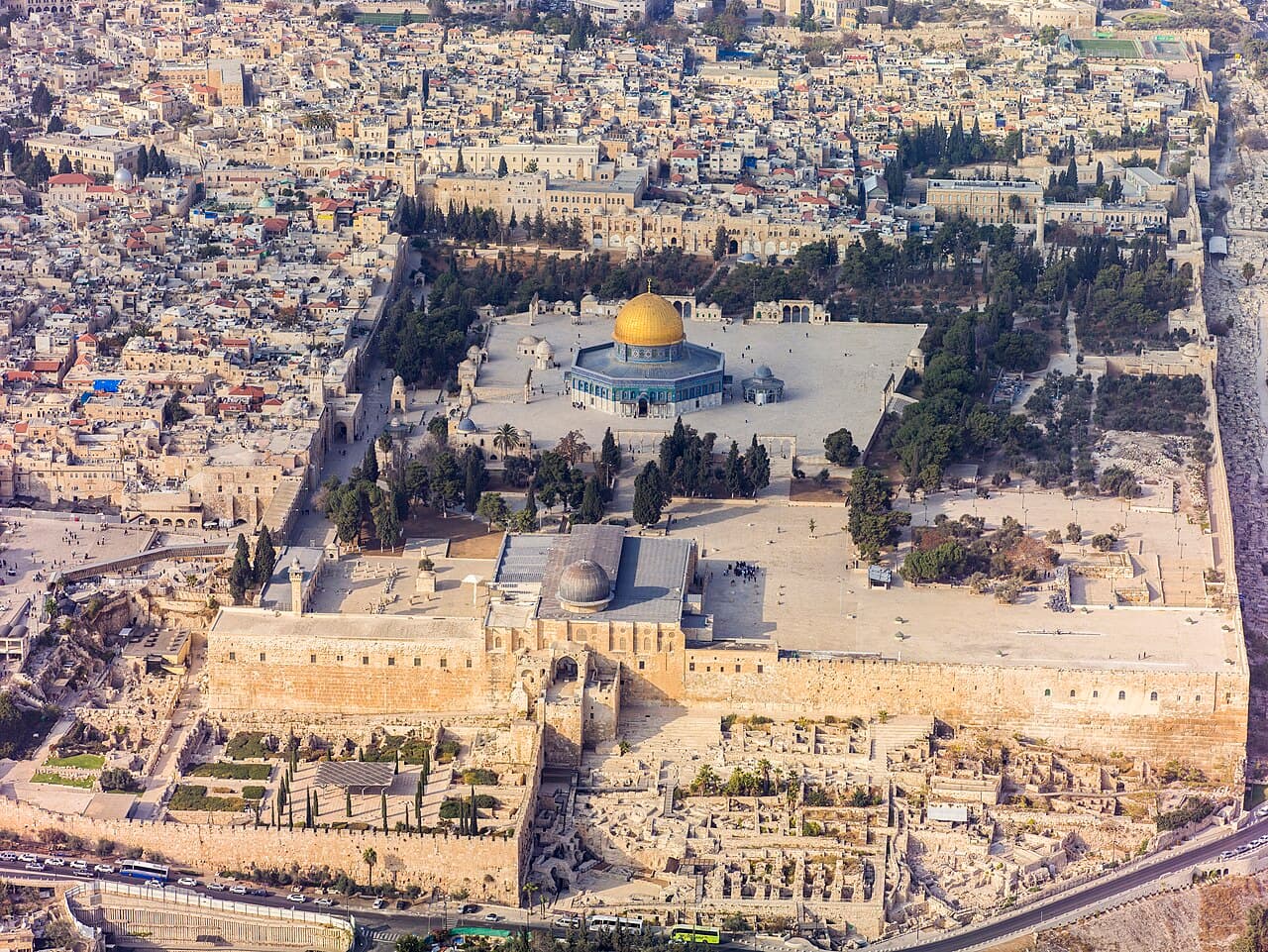
Andrew Shiva / Wikipedia, CC BY-SA 4.0, via Wikimedia Commons
Temple Mount / Haram al-Sharif
Har HaBayit (הר הבית) in Hebrew, Haram al-Sharif (الحرم الشريف) in Arabic
Also known as: Noble Sanctuary, Mount Moriah
Religions: Judaism, Islam, Christianity | Place Type: Religious complex | Region: Middle East
Overview
The Temple Mount, known in Hebrew as Har HaBayit and in Arabic as Haram al-Sharif (The Noble Sanctuary), is one of the most religiously significant and politically sensitive sites in the world. It is a large, elevated plaza located in the Old City of Jerusalem. The site contains the iconic Dome of the Rock with its golden dome and the Al-Aqsa Mosque.
Present
The site operates under a complex arrangement called the "Status Quo." Israel has had sovereignty since 1967, but day-to-day civilian management is handled by the Jerusalem Islamic Waqf, an Islamic religious trust. Jordan maintains a custodial role over the Muslim holy sites.
Muslims are permitted to pray within the compound. Non-Muslims may visit during specific hours but are traditionally forbidden from praying on the Mount itself. Jews pray at the Western Wall plaza below. The site is frequently a flashpoint for political and religious tensions.
Rituals: Thousands of Muslims gather at the Al-Aqsa Mosque for congregational prayers, particularly on Fridays. While Jewish prayer is concentrated at the Western Wall below the plaza, many pilgrims visit the area to connect with its historical and spiritual heritage.
Religious Significance
Judaism
The Temple Mount is the holiest site in Judaism. It is the location where the First Temple (built by King Solomon) and the Second Temple once stood. Jewish tradition holds it as the site of Mount Moriah, where Abraham is believed to have bound his son Isaac for sacrifice (the Binding of Isaac).
Jews worldwide face the Temple Mount during prayer. The Western Wall is a surviving retaining wall of the Second Temple complex and a major Jewish pilgrimage site. It is the closest place where Jews are permitted to pray.
Islam
It is the third holiest site in Islam (after Mecca and Medina). Muslims call it Haram al-Sharif (The Noble Sanctuary). It contains the Dome of the Rock shrine and the Al-Aqsa Mosque. Islamic tradition holds that the Prophet Muhammad ascended to heaven from the Foundation Stone housed within the Dome of the Rock following his Night Journey from Mecca to the Temple Mount (Isrāʾ and Miʿrāj).
Christianity
The site is also significant for Christians due to its connection to the life and teachings of Jesus, who is recorded in the New Testament as teaching within the Temple courts.
History & Structure
The First Temple (Solomon's Temple) was built in the 9th century BCE and served as the center of Jewish worship until the Babylonians destroyed it in the 5th century BCE. The Second Temple was then completed after Jews returned from exile in Babylon. King Herod the Great extensively renovated and expanded it between 19 BCE and 63 CE, creating the massive platform visible today.
After the Roman destruction of the Second Temple in the late 1st century CE, the site remained largely undeveloped until the early Islamic period. During this time, the Dome of the Rock was constructed in the late 7th century by Caliph Abd al-Malik ibn Marwan, followed by the completion of the Al-Aqsa Mosque in the early 8th century.
The Dome of the Rock features a golden dome (originally made of gold, now aluminum covered in gold leaf) and intricate blue-tiled exterior walls with Quranic inscriptions. The Al-Aqsa Mosque is a large rectangular structure with a silver dome.
The Ancient Temples: The First Temple was built by King Solomon in the 10th century BCE and destroyed by the Babylonians in 586 BCE. The Second Temple was completed in 515 BCE, later renovated by Herod the Great, and destroyed by the Romans in 70 CE.
Dome of the Rock: Completed in 691 CE, this structure features a prominent golden dome and was built over the Foundation Stone.
Al-Aqsa Mosque: This large mosque was completed in the early 8th century CE and has served as a primary place of worship for centuries.
The Retaining Walls: The plaza is supported by ancient walls, the most famous of which is the Western Wall, a remnant of the Second Temple expansion.
Practical Information
- Admission
- Free.
- Dress Code
- Modest dress required for all visitors. Women should cover shoulders and knees. Men should wear long pants.
- Getting There
- Enter Jerusalem's Old City through the Dung Gate, then proceed to the Western Wall plaza and the Mughrabi Gate.
- Hours
- Non-Muslim visitors: Summer (Apr-Sep) 8:30 AM - 11:30 AM and 1:30 PM - 2:30 PM; Winter (Oct-Mar) 7:30 AM - 10:30 AM and 12:30 PM - 1:30 PM. Closed Fridays, Saturdays, and Muslim holidays.
- Location
- Old City of Jerusalem, accessible through the Mughrabi Gate near the Western Wall plaza (only entrance for non-Muslims).
- Restrictions
- Non-Muslims cannot enter the Dome of the Rock or Al-Aqsa Mosque. No non-Muslim religious objects (prayer books, crosses) permitted. No Israeli flags. Prayer and religious rituals by non-Muslims prohibited.
- Tips
- - Bring passport for identification. - Arrive early to avoid long security lines. - Hours may change without notice due to security concerns.