
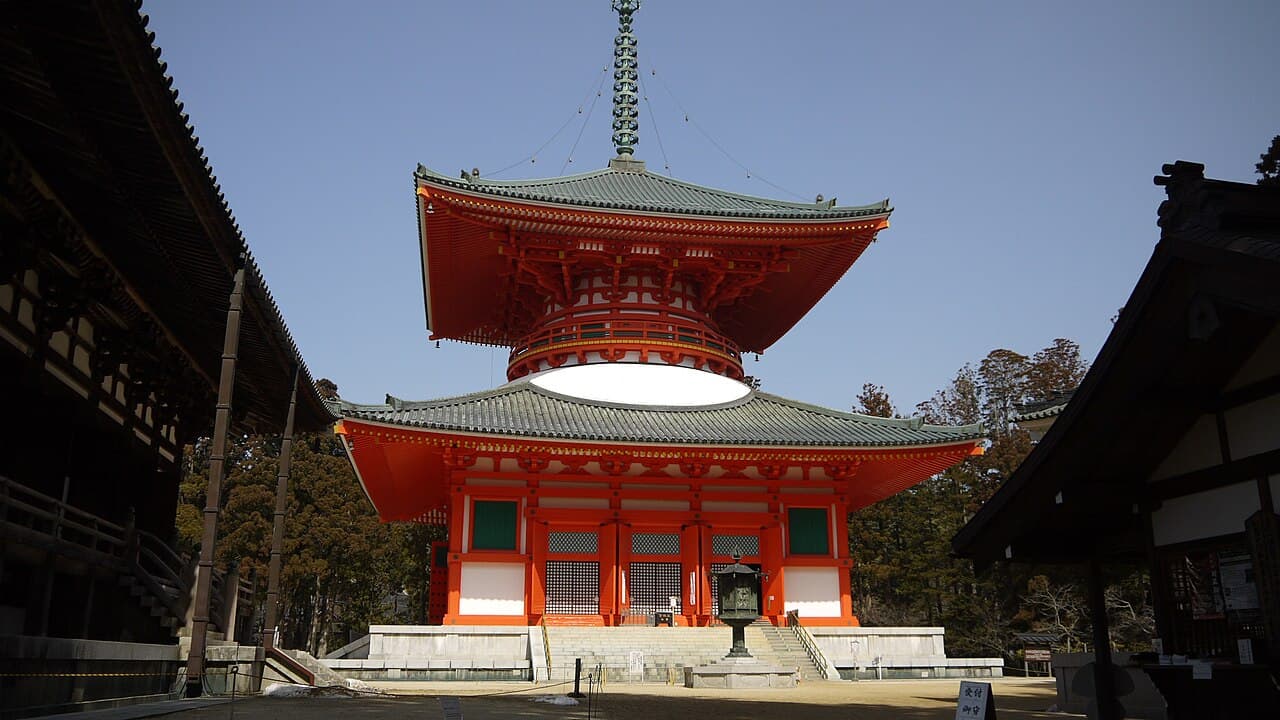
baggio4ever, CC BY 3.0, via Wikimedia Commons
Mount Kōya
高野山 (Kōyasan)
Also known as: Mount Koya, Koyasan, Koya-san
Religions: Buddhism | Place Type: Religious complex | Region: Asia | UNESCO World Heritage Site
Overview
Mount Kōya is a sacred mountain in Wakayama Prefecture, Japan, located approximately 90 kilometers south of Osaka. It serves as the world headquarters of Shingon Buddhism and is home to a temple town with over 117 temples established on an 800-meter-high forested plateau surrounded by eight peaks. Founded in 816 CE by the Buddhist monk Kūkai (also known as Kōbō Daishi), Mount Kōya is one of Japan's most important religious sites and a major pilgrimage destination.
Present
Mount Kōya functions as an active monastic center with approximately 600 priests and serves as headquarters for the Kōyasan Shingon sect, which has over 4,000 affiliated temples and 10 million followers worldwide. The temple town of Kōya comprises 117 temples, including Kongōbu-ji, Danjō Garan, and Ōkunoin. Kōyasan University, dedicated to religious studies, operates on the mountain.
The morning prayer ceremony is conducted in Japanese but welcomes all visitors. Activities such as shakyo (sutra copying), meditation, and fire ceremonies are offered at various temples. The Ōkunoin cemetery remains a deeply reverent site where visitors maintain silence and refrain from photography.
The complex attracts approximately one million visitors annually. The Kōyasan Chōishi Michi, a traditional pilgrimage path marked with stone markers every 109 meters, remains a popular walking route.
Religious Significance
Shingon Buddhism
Mount Kōya is the center of Shingon Buddhism, an esoteric Buddhist sect introduced to Japan in 805 CE by Kūkai, one of Japan's most significant religious figures. The name "Shingon" means "true word" and refers to mantras and esoteric teachings. Kūkai traveled to China in 804-806 CE to study Tantric Buddhism under Master Huiguo at Qinglong Temple in Chang'an (modern Xi'an). He returned to Japan as the eighth patriarch of esoteric Buddhism, establishing Shingon as a major Buddhist school. The practice emphasizes attaining enlightenment in one's present body through meditation, mantras, mudras (hand gestures), and mandala visualization.
According to legend, while in China, Kūkai threw a three-pronged vajra (ritual implement) eastward, praying it would land at the ideal location for establishing a training center for esoteric Buddhism in Japan. The vajra landed on Mount Kōya, caught in a pine tree (the site is marked today). Kūkai chose the location because the surrounding eight peaks resembled a lotus flower, a symbol of enlightenment in Buddhism.
Kōbō Daishi's Eternal Meditation
Central to Mount Kōya's religious significance is the belief that Kūkai did not die but entered eternal meditation (nyūjō) in 835 CE at age 62. His mausoleum at Ōkunoin is the most sacred site on the mountain. Followers believe he still sits in deep meditation in the inner chamber, awaiting Maitreya Buddha. Monks bring meals to the mausoleum twice daily as if Kūkai were alive. The Ōkunoin cemetery, Japan's largest, contains over 200,000 graves as devotees wish to be buried near the eternal master.
Pilgrimage
Mount Kōya is both the start and end point of the Shikoku 88 Temple Pilgrimage, Japan's most famous Buddhist pilgrimage route. The mountain attracts pilgrims and spiritual seekers from throughout Japan and internationally.
History & Structure
Construction began in 816 CE when Emperor Saga granted Kūkai permission to establish a mountain monastery. Kūkai, accompanied by followers, began clearing the mountain and constructing training facilities for esoteric Buddhism. The Danjō Garan (sacred temple precinct) was among the first complexes built, though Kūkai died before its completion in 835 CE. His disciple Shinzen continued the work, completing the Konpon Daitō (fundamental great pagoda) around 887 CE. This 48.5-meter-tall vermillion pagoda, rebuilt in 1937, contains a three-dimensional mandala with five Buddha statues representing cosmic truth.
Major Structures: Kongōbu-ji serves as the head temple of Kōyasan Shingon Buddhism, originally built in 1593 by warlord Toyotomi Hideyoshi in memory of his mother. The temple features Japan's largest rock garden, Banryūtei, depicting dragons emerging from clouds. The Danjō Garan complex includes the Kondō (main hall), Saitō (western pagoda), and shrines honoring Shinto deities who protect the mountain, reflecting the historical fusion of Shinto and Buddhism in Japan. Ōkunoin contains the Tōrōdō (Lantern Hall) with over 10,000 perpetually burning lanterns donated by devotees.
Historical Development: Throughout the Heian period (794-1185), Mount Kōya grew as a center of Buddhist learning and practice. During the Edo period (1603-1867), it received patronage from the Tokugawa shogunate, with the third shogun Tokugawa Iemitsu constructing an elaborate family mausoleum that took ten years to build. In 2004, Mount Kōya was designated a UNESCO World Heritage Site as part of "Sacred Sites and Pilgrimage Routes in the Kii Mountain Range."
Practical Information
- Admission
- Kongōbu-ji: ¥500. Konpon Daitō: ¥500. Ōkunoin Tōrōdō: free. Some temples free, others charge ¥200-500.
- Dress Code
- Modest clothing. Remove shoes when entering temple buildings. At shukubō, respect quiet hours and Buddhist customs. **Best Time:** Spring (cherry blossoms) and autumn (fall foliage) are beautiful but crowded. Winter is quiet but cold (snow possible).
- Getting Around
- The main sites are walkable. Rent bicycles or use local buses (¥300-500 per ride or ¥900 day pass).
- Getting There
- From Osaka's Namba Station, take the Nankai Kōya Line Limited Express to Gokurakubashi Station (1.5-2 hours, ¥1,860). At Gokurakubashi, board a cable car to the mountaintop (5 minutes, ¥500). Local buses connect sites across the mountain. Two-day Kōyasan World Heritage Ticket (¥3,200) includes roundtrip train, cable car, and unlimited bus travel. From Kyoto, change at Osaka.
- Hours
- Individual temples vary. Kongōbu-ji: 08:30-17:00 (entry until 16:30). Ōkunoin: open 24 hours (Tōrōdō: 06:00-17:30). Danjō Garan buildings: generally 08:30-17:00.
- Location
- Kōyasan is located in northern Wakayama Prefecture in the Kii Mountains.
- Shukubō (Temple Lodging)
- Reserve in advance, especially March-May and October-November. Include dinner and breakfast. Curfew usually 21:00-22:00. Morning prayers 06:00. Shukubō rates range from ¥9,000-15,000 per person including two meals. About 50 temples offer shukubō, allowing visitors to experience monastic life by staying overnight, participating in morning prayers (gongyo) at 6:00 AM, and eating shōjin ryōri (traditional Buddhist vegetarian cuisine). Guests sleep in tatami-mat rooms with futon bedding.
- Special Notes
- Ōkunoin cemetery requires respectful behavior—no loud talking, eating, drinking, or photography.
- Tours
- Free volunteer English-speaking guides available by reservation through Kōyasan Tourism Association (2-week advance booking recommended).