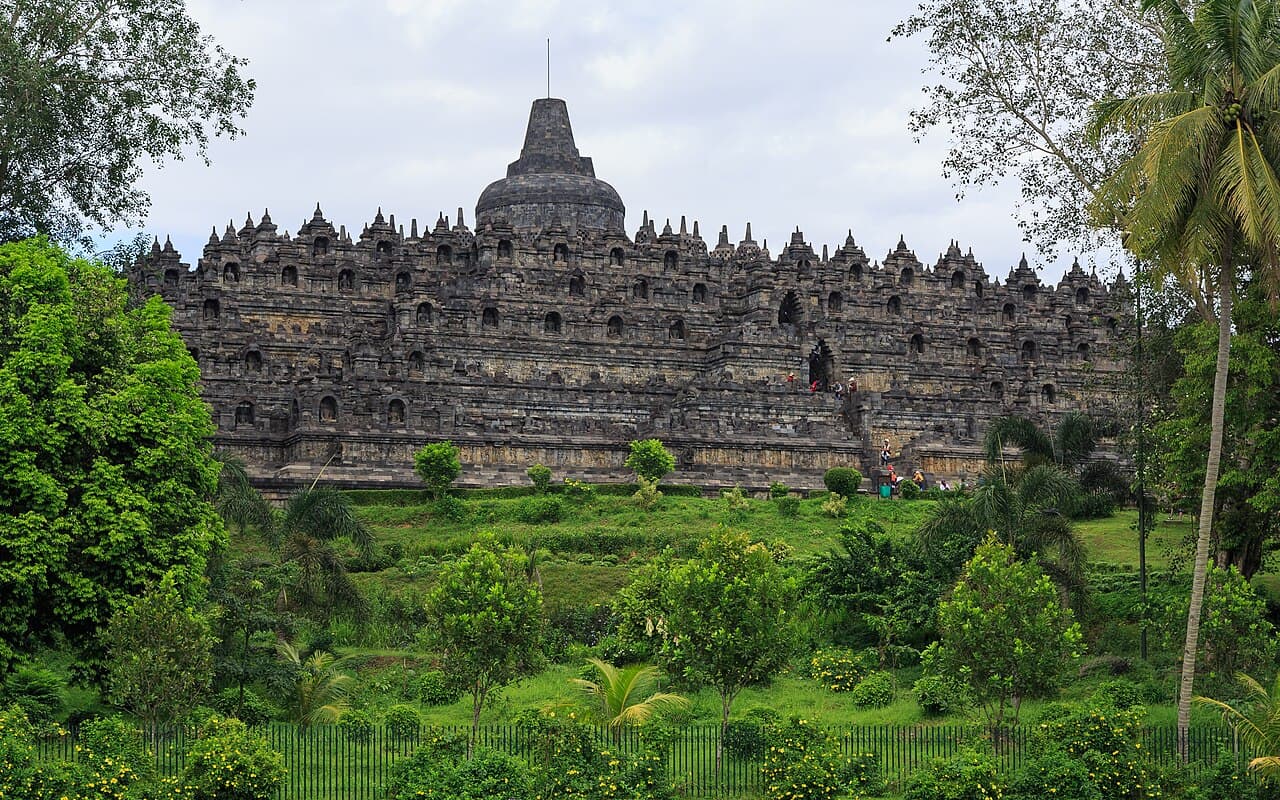
CEphoto, Uwe Aranas, CC BY-SA 3.0, via Wikimedia Commons
Borobudur Temple
Candi Borobudur
Also known as: Barabudur
Religions: Buddhism | Place Type: Temple | Region: Asia | UNESCO World Heritage Site
Overview
Borobudur is the world's largest Buddhist temple, located in Central Java, Indonesia. Built in the 9th century during the Sailendra Dynasty, this massive Mahayana Buddhist monument consists of nine stacked platforms topped by a central dome, decorated with 2,672 relief panels and originally 504 Buddha statues. The temple is designed as a three-dimensional mandala representing Buddhist cosmology and the path to enlightenment.
Present
Pilgrimage Practice: Devotees perform pradakshina (circumambulation), walking clockwise while ascending through the galleries, symbolically progressing through the stages a Bodhisattva must achieve before reaching Buddhahood. The temple functions as both a shrine to the Buddha and a place for Buddhist pilgrimage.
Vesak (Waisak) Celebration: Once yearly during the full moon in May or June, thousands of Indonesian Buddhists observe Vesak (Waisak), commemorating Buddha's birth, death, and enlightenment. The ceremony involves walking from Mendut Temple to Pawon Temple and ending at Borobudur.
While the temple itself is a sacred site, the Borobudur Archaeological Park contains two specialized museums connected to the temple.
Borobudur is managed by the Indonesian government. Visitors must wear provided bamboo slippers when climbing the temple to reduce erosion. Organized tours with guides are mandatory for most visitors. The site hosts annual Vesak (Waisak) celebrations with thousands of participants.
A daily visitor quota of 1,200 people (as of recent regulations) helps preserve the monument. Conservation challenges include vandalism, weathering from tropical climate, earthquakes (2006 earthquake caused significant damage), and tourism pressure. The Indonesian government invested 47 million yuan in restoration for the 2008 Olympics.
Borobudur appears on Indonesian currency and has become a national symbol, inspiring hotels, universities, and cultural institutions named after it.
Religious Significance
Buddhism (Mahayana)
Borobudur represents the Buddhist conception of the universe divided into three spheres. The structure embodies the journey from the earthly realm to spiritual enlightenment:
Kamadhatu (Sphere of Desires)
The hidden base represents the world where humans are bound to desires and worldly attachments. Originally visible, it was later covered. The "hidden foot" contains 160 reliefs depicting karmic cause and effect.
Rupadhatu (Sphere of Forms)
The five square terraces represent the realm where humans abandon desires but remain attached to name and form. The galleries contain 1,460 narrative relief panels depicting the life of Buddha, Jataka tales (stories of Buddha's previous lives), and other Buddhist teachings. These serve as a visual textbook for pilgrims learning Buddhist doctrine.
Arupadhatu (Sphere of Formlessness)
The three circular platforms and central stupa represent the realm beyond name and form - the achievement of Nirvana. Here, 72 perforated stupas each contain a Buddha statue (some with diamond-shaped openings, others square-shaped). The central stupa, originally containing relics, symbolizes the ultimate goal of enlightenment.
History & Structure
Built by the Sailendra Dynasty between 778 and 850 CE, Borobudur is the world's largest Buddhist temple. It was constructed using two million blocks of volcanic stone, fitted together without mortar. The design is shaped like a giant mandala when viewed from above, blending Buddhist cosmology with local Javanese traditions.
Following the decline of Buddhist kingdoms and the shift of power to East Java, the site was abandoned and eventually buried under volcanic ash and jungle growth. It remained hidden until its rediscovery in 1814 by Sir Thomas Stamford Raffles.
Between 1975 and 1982, UNESCO led a massive restoration project that involved dismantling and reassembling over one million stones to install modern drainage and stabilize the structure. Designated a UNESCO World Heritage Site in 1991, Borobudur is once again a major center for Buddhist pilgrimage and a symbol of Indonesian heritage.
Practical Information
- Admission
- Peak season (April-October): IDR 50,000 for Indonesians, approximately $25-30 USD for foreigners. Off-season (November-March): slightly lower. Combination tickets available for multiple sites. Temple climbing now limited and requires advance booking.
- Best Time
- Early morning (6:00-9:00 AM) for sunrise and fewer crowds, or late afternoon. Dry season (April-October) is busiest. Rainy season (November-March) offers fewer tourists but potential rain.
- Dress Code
- Modest dress recommended. Bamboo slippers provided and mandatory for walking on the temple structure.
- Getting There
- From Yogyakarta (1.5 hours): public bus from Jombor Terminal, private car/driver, or organized tour. From Jakarta: train to Yogyakarta then onward transport.
- Hours
- Park opens 6:00 AM-5:00 PM daily. Temple access with guide 6:00 AM-5:00 PM. Museum 10:00 AM-5:00 PM (closed Fridays).
- Location
- Magelang Regency, 40 km northwest of Yogyakarta, Central Java, Indonesia. Near the town of Muntilan.
- Nearby Sites
- Mendut and Pawon temples (part of same Buddhist complex). Visit the "hidden foot" viewing section at southeast corner.
- Photography
- Photography allowed.
- Tips
- - Hire a guide for full understanding of symbolism. - Allow 2-3 hours minimum. - Bring water, sunscreen, and hat.