
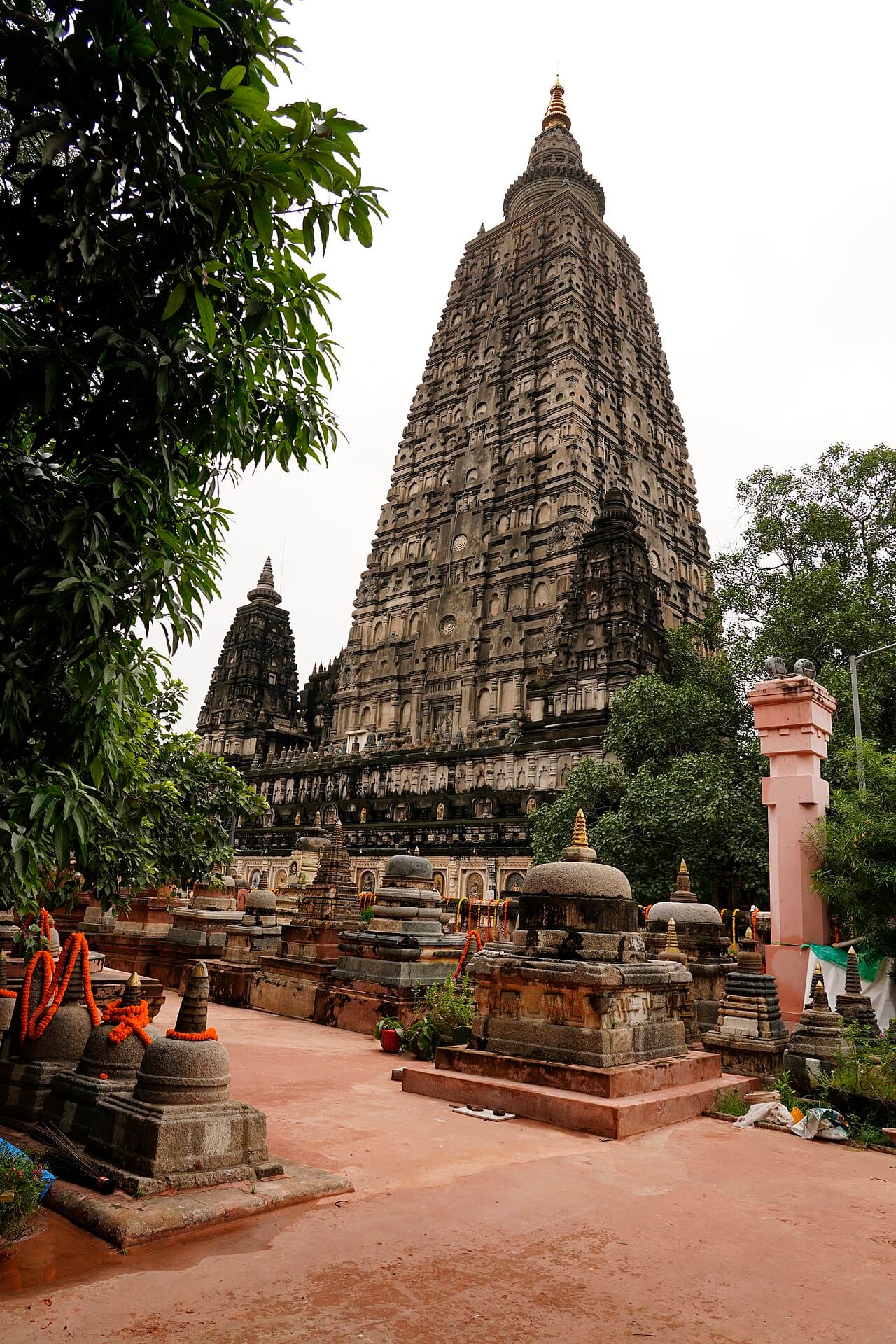
Amitabha Gupta, CC BY 4.0, via Wikimedia Commons
Mahabodhi Temple Complex
Mahābodhi Mahāvihāra
Also known as: Bodh Gaya Temple, Great Awakening Temple
Religions: Buddhism | Place Type: Temple | Region: Asia | UNESCO World Heritage Site
Overview
The Mahabodhi Temple Complex in Bodh Gaya, Bihar, India, marks the site where Siddhartha Gautama attained enlightenment and became the Buddha in the 5th–6th century BCE. The main brick temple, rising 55 meters in height, enshrines the sacred Bodhi Tree, a descendant of the original tree under which the Buddha meditated. UNESCO designated this site a World Heritage Site in 2002 as one of the four holiest sites in Buddhism.
Present
The temple complex is managed by the Bodh Gaya Temple Management Committee, which includes representatives from the Indian government and Buddhist organizations. The site attracts hundreds of thousands of pilgrims and visitors annually from around the world, representing all Buddhist traditions including Theravada, Mahayana, and Vajrayana.
The complex includes meditation halls, monasteries built by different Buddhist countries, and gardens for contemplation. Continuous prayer and meditation occur throughout the day and night, with monks and pilgrims from Tibet, Thailand, Myanmar, Sri Lanka, Japan, and other Buddhist nations maintaining a constant presence.
The site hosts major celebrations during Vesak (Buddha's birthday) in April-May and Bodhi Day in December, which commemorate Buddha's enlightenment. The Dalai Lama and other senior Buddhist leaders regularly visit and teach at Bodh Gaya.
Religious Significance
Buddhism
The Mahabodhi Temple Complex is the holiest site in Buddhism, marking the exact location of Buddha's enlightenment (bodhi). According to tradition, Prince Siddhartha Gautama sat in meditation beneath a pipal tree (Ficus religiosa) here and attained complete awakening after 49 days, becoming the Buddha ("the Awakened One"). The Vajrasana, or Diamond Throne, a red sandstone slab beneath the Bodhi Tree, marks the precise spot of enlightenment. The current Bodhi Tree is believed to be a direct descendant of the original tree, propagated through cuttings over centuries.
Buddha himself identified this as one of four essential pilgrimage sites for his followers, along with Lumbini (his birthplace), Sarnath (his first sermon), and Kushinagar (his death). Pilgrims circumambulate (walk clockwise around) the temple and tree as a devotional practice called pradakshina. The site represents the moment when Buddha discovered the Middle Way and the Four Noble Truths, the foundational teachings of Buddhism. For Buddhists, visiting Bodh Gaya and meditating under the Bodhi Tree is considered the most sacred pilgrimage, offering a direct connection to the moment of Buddha's awakening.
History & Structure
Ancient Period: Emperor Ashoka visited the site around 260 BCE and erected the Ashoka Pillar. He commissioned the first temple structure and established a monastery. The original pipal tree was damaged during persecutions but was replanted from a cutting that had been taken to Sri Lanka.
Current Temple: The present brick temple was built during the late Gupta period in the 5th-6th century CE, though it has undergone several restorations. The temple rises 55 meters (180 feet) in a pyramidal form, constructed entirely of brick with intricate carvings. Four smaller towers surround the main spire, and the entire structure stands on a high platform.
Vajrasana: The Diamond Throne beneath the Bodhi Tree dates to the 3rd century BCE and is believed to mark the exact spot of Buddha's meditation and enlightenment.
Bodhi Tree: The current tree is considered a direct descendant of the original through successive plantings. A cutting from the original tree was taken to Sri Lanka in the 3rd century BCE by Ashoka's daughter Sanghamitta, and a sapling from that tree was brought back to Bodh Gaya in 1881.
Restoration: The temple was restored by the British archaeologist Alexander Cunningham in the 1880s.
Practical Information
- Admission
- Free entry to the main temple complex. Separate tickets may be required for archaeological museum.
- Best Time to Visit
- October to March for pleasant weather. Avoid peak summer (April-June). The site is busiest during Vesak (April-May) and Bodhi Day (December).
- Dress Code
- Modest clothing required. Remove shoes before entering temple buildings. Many pilgrims wear white.
- Getting There
- Nearest airport is Gaya (17 km). Gaya Junction railway station is well-connected to major Indian cities. Regular buses and taxis available from Gaya.
- Hours
- The temple complex is open from sunrise to sunset daily (approximately 5:00 AM to 9:00 PM). The Bodhi Tree area has extended hours for meditation.
- Location
- Bodh Gaya is in Gaya district, Bihar, approximately 96 km from Patna and 16 km from Gaya city.
- Meditation
- Designated meditation areas are available under the Bodhi Tree and throughout the complex. Visitors may join meditation sessions or practice individually.
- Nearby Sites
- Dungeshwari Cave Temples (12 km, where Buddha practiced asceticism), Sujata Village (where he accepted milk rice before enlightenment).
- Photography
- Generally allowed in courtyards. Respectful photography only; avoid flash inside temple buildings.