
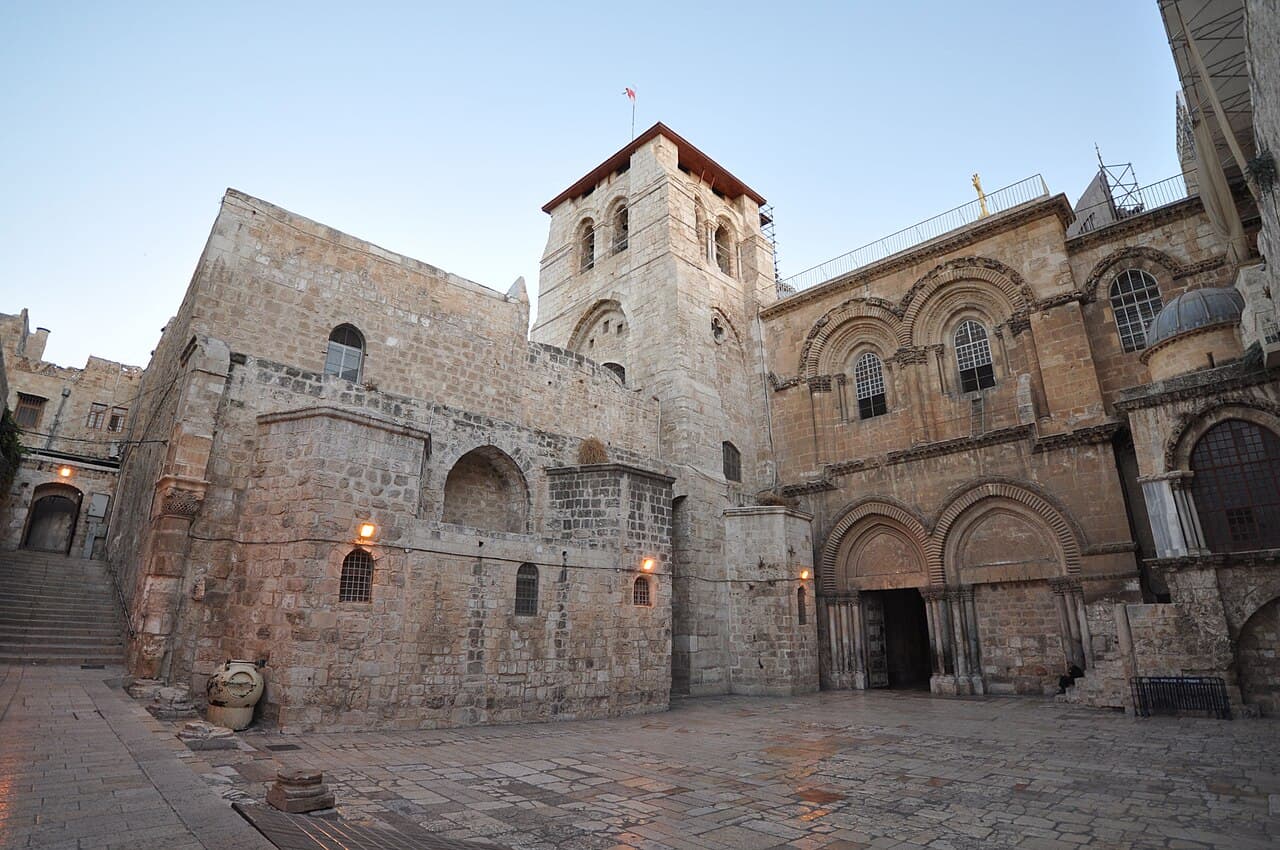
Jorge Lascar, CC BY 2.0, via Wikimedia Commons
Church of the Holy Sepulchre
Knesiyyat HaKever HaKadosh (כנסיית הקבר הקדוש) in Hebrew, Kanīsat al-Qiyāma (كنيسة القيامة) in Arabic
Also known as: Church of the Resurrection, Church of the Anastasis
Religions: Christianity | Place Type: Church | Region: Middle East
Overview
The Church of the Holy Sepulchre is a complex series of interconnected buildings in the Christian Quarter of Jerusalem's Old City. It is the holiest site in Christianity, believed to be built on the locations of both Jesus's crucifixion (Calvary or Golgotha) and his tomb (the Holy Sepulchre). The church is shared by six Christian denominations and has been a major pilgrimage destination since the 4th century.
Present
The church operates under an agreement called the "Status Quo," established in 1853, which governs the rights and responsibilities of six Christian denominations:
Greek Orthodox Patriarchate. Roman Catholic Church (Franciscan Custody). Armenian Apostolic Church. Coptic Orthodox Church. Syriac Orthodox Church. Ethiopian Orthodox Church.
Each denomination controls specific areas and times for worship. The Status Quo is so precise that even small changes require unanimous agreement. Famously, a ladder placed on a ledge above the entrance in the 18th century has remained in place because no denomination can agree to move it.
The church keys are held by two Muslim families, the Joudeh and Nusseibeh families, who have opened and closed the doors daily since the 12th century - a practice designed to prevent disputes among the Christian communities.
Religious Significance
Christianity
This church encompasses the two holiest sites in Christianity:
Calvary (Golgotha)
The place where Jesus was crucified. According to the Gospels, Jesus was crucified at "the place of the skull" (Golgotha in Aramaic, Calvary in Latin), located outside the city walls at the time. Visitors can climb stairs to reach the spot, now marked by ornate altars in two chapels - one Greek Orthodox, one Catholic. The Rock of Calvary is visible through glass and can be touched through an opening.
The Holy Sepulchre (Tomb of Jesus)
The tomb where Jesus was buried and, according to Christian belief, rose from the dead on the third day. This event, called the Resurrection, is the central event of the Christian faith. The tomb is enclosed within a small chapel called the Edicule (from Latin aedicule, "little house").
The church also contains other significant sites including:
The Stone of Anointing, where Jesus's body was prepared for burial. The site where Jesus's body was taken down from the cross. The Chapel of Adam, according to tradition located beneath Calvary.
The final five Stations of the Cross along the Via Dolorosa are located within the church.
History & Structure
In 326 CE, Helena, mother of Roman Emperor Constantine the Great, traveled to the Holy Land to identify sites connected to Jesus. She ordered the destruction of a Roman temple to Venus/Aphrodite built over the site, and workmen discovered what was believed to be the tomb of Jesus beneath it.
Emperor Constantine ordered the construction of a grand church, which was completed in 335 CE and named the Church of the Anastasis (Resurrection). This original church was destroyed by the Fatimid Caliph Al-Hakim in 1009.
The Crusaders rebuilt the church in the 12th century, and much of the current structure dates from this period. The church's distinctive paired entrance doorways and Romanesque façade are Crusader-era constructions.
The Edicule, the shrine enclosing the tomb, was last rebuilt in 1810 after a fire. It was extensively restored between 2016-2017, the first major renovation in 200 years.
The church's complex layout reflects its shared ownership and the many chapels and spaces claimed by different Christian denominations over centuries.
Practical Information
- Accessibility
- The church has many stairs and narrow passages. Limited accessibility for wheelchairs.
- Admission
- Free.
- Dress Code
- Modest dress required. Cover shoulders and knees. No shorts or sleeveless tops.
- Getting There
- Walk through Jerusalem's Old City from Jaffa Gate or Damascus Gate following signs to the Christian Quarter. The church is well-marked.
- Hours
- - Summer (April-September): 5:00 AM - 9:00 PM - Winter (October-March): 4:00 AM - 7:00 PM - Hours may vary; check the Christian Information Center for current times
- Location
- Christian Quarter, Old City of Jerusalem. The church is located at the end of the Via Dolorosa pilgrimage route.
- Photography
- Photography is generally permitted but be respectful during services
- Tips
- - Arrive early (before 8:30 AM) to avoid large tour groups. - Lines for the Edicule (tomb) can be very long - sometimes 1+ hour wait. - The church can be extremely crowded, especially during Easter. - Multiple services in different languages occur throughout the day.